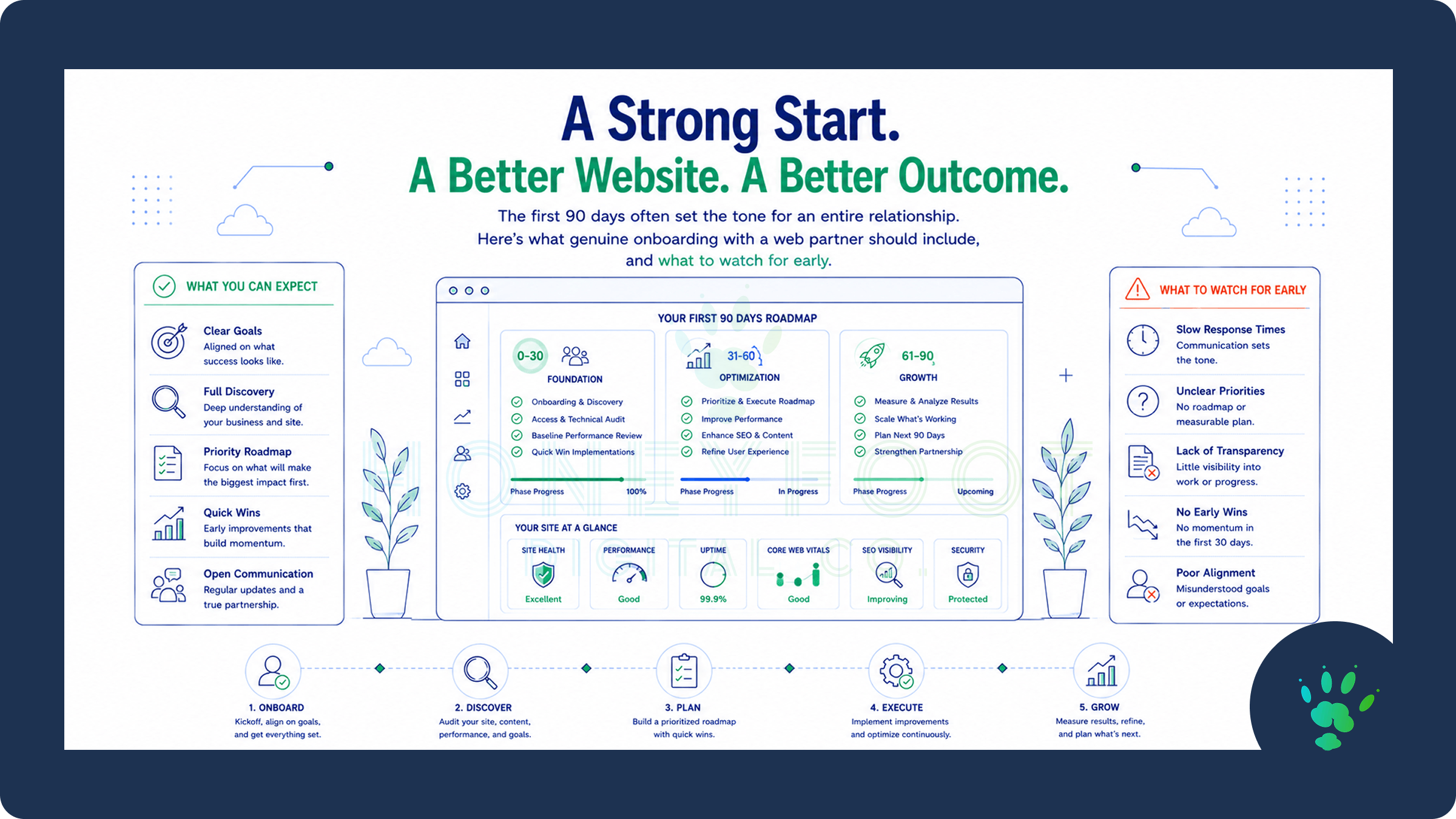
The Onboarding Period Sets the Tone for Everything That Follows
Most business owners spend real energy choosing a new web partner: comparing options, asking questions, reviewing past work. Then, once the decision is made, that scrutiny tends to disappear. The assumption is that the hard part is over. In practice, the first 90 days of a new relationship often determine more about how it will actually go than the selection process that preceded it.
This period deserves the same attention as the decision to switch in the first place, because it's where a relationship either establishes the habits of a genuine partnership or quietly settles into the same patterns that made the previous arrangement disappointing. The irony is that most business owners who invest heavily in choosing well then coast through the very period that determines whether that choice actually pays off.
Why the First 90 Days Matter More Than They Seem To
There's a reason so much attention gets paid to onboarding across nearly every kind of client relationship, not just web partnerships. Businesses that study how relationships form generally find the same pattern: expectations set (or left unset) early tend to define the relationship for a long time afterward. A slow, disorganized, or vague start rarely course-corrects itself into something better later. It tends to simply become the norm.
This matters directly for a web partnership because the work itself often continues long after the initial build or transition is complete. Whether the outcome is a smooth, attentive relationship or a quietly reactive one is frequently decided in these first few months, well before anyone would think to call it a pattern.
What Should Happen in the First Two Weeks
The earliest phase of a new relationship should be organized and specific, not vague. At minimum, a business owner should expect:
A clear access and asset transfer. Domain, hosting, analytics, and any other accounts should be confirmed and documented, not left as an open question to be sorted out later.
A real discovery conversation. Not a form to fill out, but an actual conversation about the business itself: what's working, what isn't, who the ideal customer is, and what the website needs to accomplish. A partner who skips this and jumps straight into technical work is optimizing for speed over understanding.
A documented starting point. A baseline understanding of where the site currently stands, whether that's performance data, existing content, technical health, or all three, so that progress later can actually be measured against something concrete.
A clear point of contact and communication rhythm. Knowing who to reach, how, and how quickly to expect a response removes one of the most common early sources of friction in a new relationship.
None of this needs to feel rushed. But it should feel intentional. A studio that treats these first two weeks as a formality to get through before “the real work” begins is signaling something about how the relationship will be run going forward.
Getting to Know the Business, Not Just the Website
A genuine onboarding process goes well beyond collecting login credentials. It should mirror the kind of discovery that happens in a real strategy session: understanding what's actually driving revenue, which offerings are growing, what a good lead looks like, and where the business is headed over the next year, not just the next project.
This matters because every recommendation that follows should be grounded in this understanding. A partner who understands the business can prioritize work that actually moves outcomes. A partner who only understands the website is left making decisions based on general best practices rather than what this particular business actually needs.

Early Signals Worth Paying Attention To
The first 90 days tend to reveal, in miniature, how the entire relationship will run. A few things worth watching for:
Responsiveness that holds steady, not just at the start. Nearly every studio is attentive in the first week. What matters more is whether that same attentiveness is still there in week eight, once the relationship has moved past the initial excitement of a new engagement.
Proactive communication, not just reactive answers. A partner worth keeping will start surfacing observations unprompted within the first few months, not simply responding when asked. If every interaction so far has been initiated by the business owner, that's worth noting early rather than waiting to see if it changes on its own.
Follow-through on what was discussed at the start. If specific priorities or concerns were raised during onboarding, they should visibly show up in the work that follows. A studio that nodded along during discovery and then proceeded as though that conversation never happened isn't actually incorporating it.
Client relationship research consistently shows that the earliest period of a working relationship carries outsized weight in determining how long it lasts and how well it performs. According to HubSpot's own research on client onboarding, even modest improvements in how a relationship starts compound into significantly better retention and outcomes over time, a pattern that holds as true for a web partnership as it does for any other client relationship.
Common Onboarding Mistakes Worth Watching For
Even well-intentioned studios can stumble in these first months, and a few patterns come up often enough to be worth naming directly.
Treating onboarding as a checklist rather than a conversation. A form asking for logins and brand colors is useful, but it isn't a substitute for an actual discussion about the business. If the entire onboarding experience feels like paperwork, that's a sign the relationship may stay transactional going forward.
Moving too fast to prove value. Some studios rush into visible changes early to demonstrate momentum, before they've actually taken the time to understand what the business needs. Fast isn't the same as right, and early changes made without real context sometimes have to be undone later.
Disappearing after the initial excitement fades. The first two weeks are often the most attentive a relationship will ever be, simply because everything is new. The real test isn't the enthusiasm of week one. It's whether that same level of attention is still present in week ten, once the account has become routine.
Vague timelines and open-ended promises. “We'll get to that soon” without a specific date or plan is a pattern worth noticing early. A partner who is organized in the first 90 days tends to stay organized. One who is loose with commitments from the start rarely tightens up later.
Building a Realistic 90-Day Roadmap
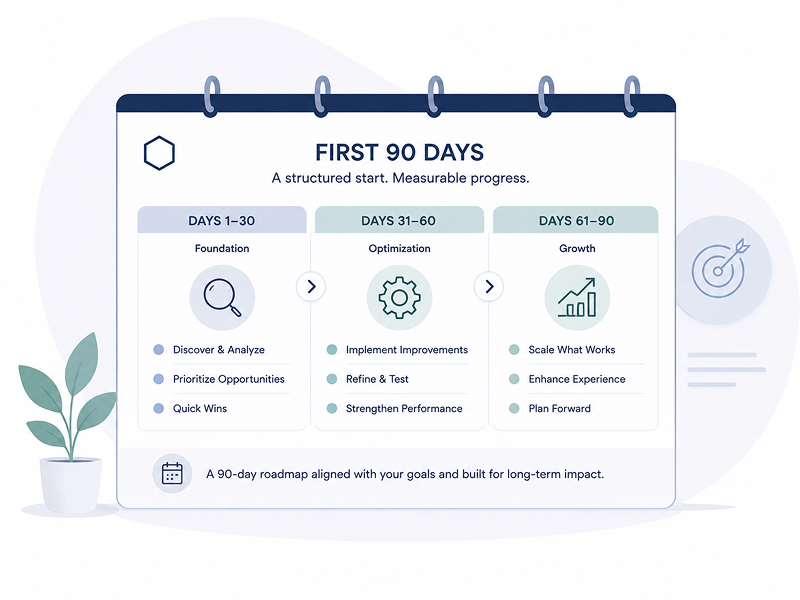
A useful way to think about the first three months is in three rough phases. The first few weeks should be about orientation: transferring access, understanding the business, and establishing a documented baseline. The middle stretch should be about addressing whatever the most pressing issues actually are, whether that's fixing something urgent, cleaning up a specific problem area, or simply stabilizing a site that was previously neglected. The final weeks of the period should start to show early, visible progress and, ideally, the outline of a longer-term plan rather than an open-ended list of ongoing tasks.
This kind of structure isn't the same thing as rigidity. A good partner will adjust based on what's actually found during discovery. But having a rough shape to the first 90 days, rather than an undefined stretch of “getting settled in,” makes it much easier for a business owner to tell whether the relationship is progressing the way it should.
What Good Should Feel Like at Day 90
By the end of the first 90 days, a business owner should have a reasonably clear picture of the relationship they're actually in. There should be a documented understanding of where the site started. There should be visible evidence of proactive thinking, not just completed requests. There should be a clear, predictable communication rhythm that doesn't require constant follow-up to maintain. And there should be at least the beginning of a longer-term plan, not just a list of tasks that have been checked off.
If 90 days in, the relationship still feels transactional, purely reactive, or difficult to get a straight answer from, that's worth taking seriously rather than assuming it will improve with more time. The patterns that show up early rarely reverse themselves later without a deliberate conversation about what needs to change.
Setting the Right Expectations From Day One
Some of the responsibility for a strong start belongs to the business owner as well. Being clear about priorities, being available for the discovery conversation, and being direct about what wasn't working in the previous arrangement all give a new partner the context needed to actually deliver a better experience. A relationship that starts with vague or withheld information is harder for even a genuinely good partner to get right.
This is also a natural moment to revisit what a genuine ongoing partnership is supposed to look like, since the first 90 days are effectively a live test of whether the new arrangement will actually meet that standard. A business owner who went through the work of evaluating whether the previous partner was the right fit and managing a careful transition has every reason to hold the new relationship to the same bar, starting from day one rather than waiting a year to find out.
The First 90 Days Are a Preview, Not a Formality
It's tempting to treat onboarding as administrative overhead standing between a decision and the actual work. In practice, it's the clearest window a business owner will get into how a partner actually operates, before the relationship settles into its long-term rhythm. Paying attention during this window, rather than simply getting through it, is one of the most useful things a business owner can do to make sure the new relationship actually delivers on the reasons for switching in the first place.
What has your experience been in the first few months of a new working relationship: organized and attentive, or already starting to feel familiar in the wrong ways? Whether you're in the middle of onboarding with a new partner or just starting to think about what a strong start should look like, it's worth having a clear picture of the standard before assuming the relationship will simply work itself out. Let's talk about what a genuine start to a web partnership should look like.
Sources and Further Reading