
A website launch is a significant moment. There is real effort behind it such as the strategy, the design decisions, the content, the testing, the final push to get everything right before it goes live. For many businesses, it feels like the conclusion of something.
For the website itself, it’s the beginning.
What happens in the months and years after a website launches determines whether that initial investment compounds in value or quietly erodes. A site that is well-built at launch but left alone will degrade though not dramatically, and rarely all at once, but steadily. Security vulnerabilities accumulate. Content grows stale. The business evolves and the site doesn’t follow. Performance that was strong on launch day drifts as the broader web standards it was built against continue to move forward.
The businesses that get the most from their websites over time aren’t the ones that build and move on. They’re the ones that treat the launch as the start of an ongoing relationship with their site, and with the people responsible for keeping it performing. Understanding why that relationship matters, and what it actually looks like in practice, is one of the more underrated decisions a business owner can make about their digital presence.
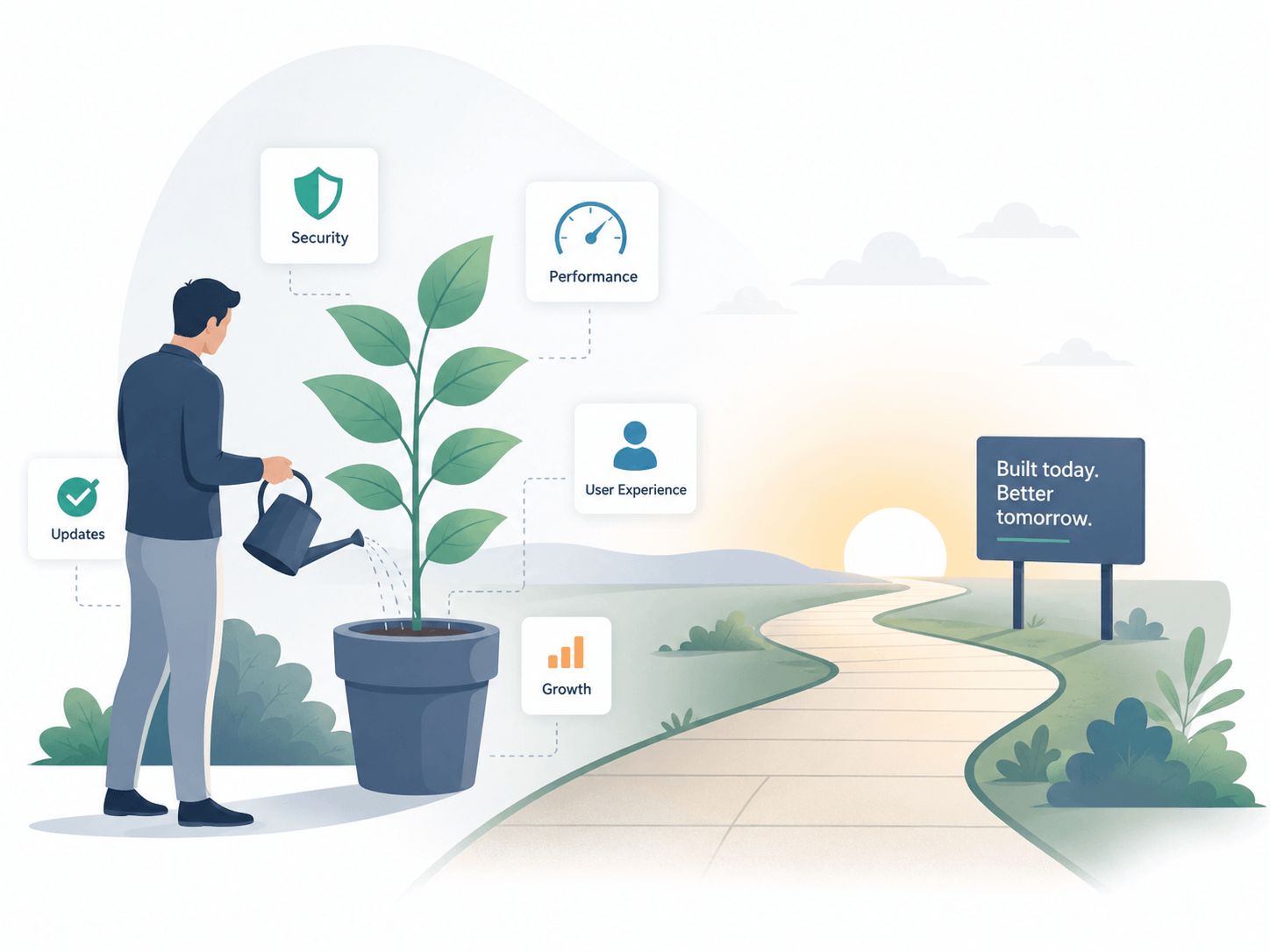
What “Launch and Leave” Actually Costs
The launch-and-leave model is more common than it should be. A business hires a vendor to build a website, the site goes live, and the engagement ends. The business is left with a finished product and no ongoing relationship to support it which means that when something breaks, when something needs updating, or when the business wants to make a change, they’re starting from scratch to find someone who can help.
This model has a cost that most businesses don’t fully account for upfront. Re-engaging a developer who didn’t build the site requires a ramp-up period while they learn its architecture. Emergency fixes are more expensive than routine maintenance. And the kind of proactive improvements such as performance tuning, content updates, conversion testing, all these that keep a site performing over time simply don’t happen without someone whose job it is to do them.
More importantly, the launch-and-leave model treats a website as a finished object rather than a living asset. A website is more like a business relationship than a piece of furniture. It needs attention, adjustment, and occasional reinvention to stay relevant to the business it represents and the visitors it’s meant to serve. A model that ends the moment the site goes live can’t provide any of that and the cost accumulates quietly in the form of a site that slowly stops performing while the business assumes it’s working fine.
Security Is Not a One-Time Consideration
One of the most concrete arguments for ongoing web partnership is security and it’s one that businesses often underestimate until something goes wrong.
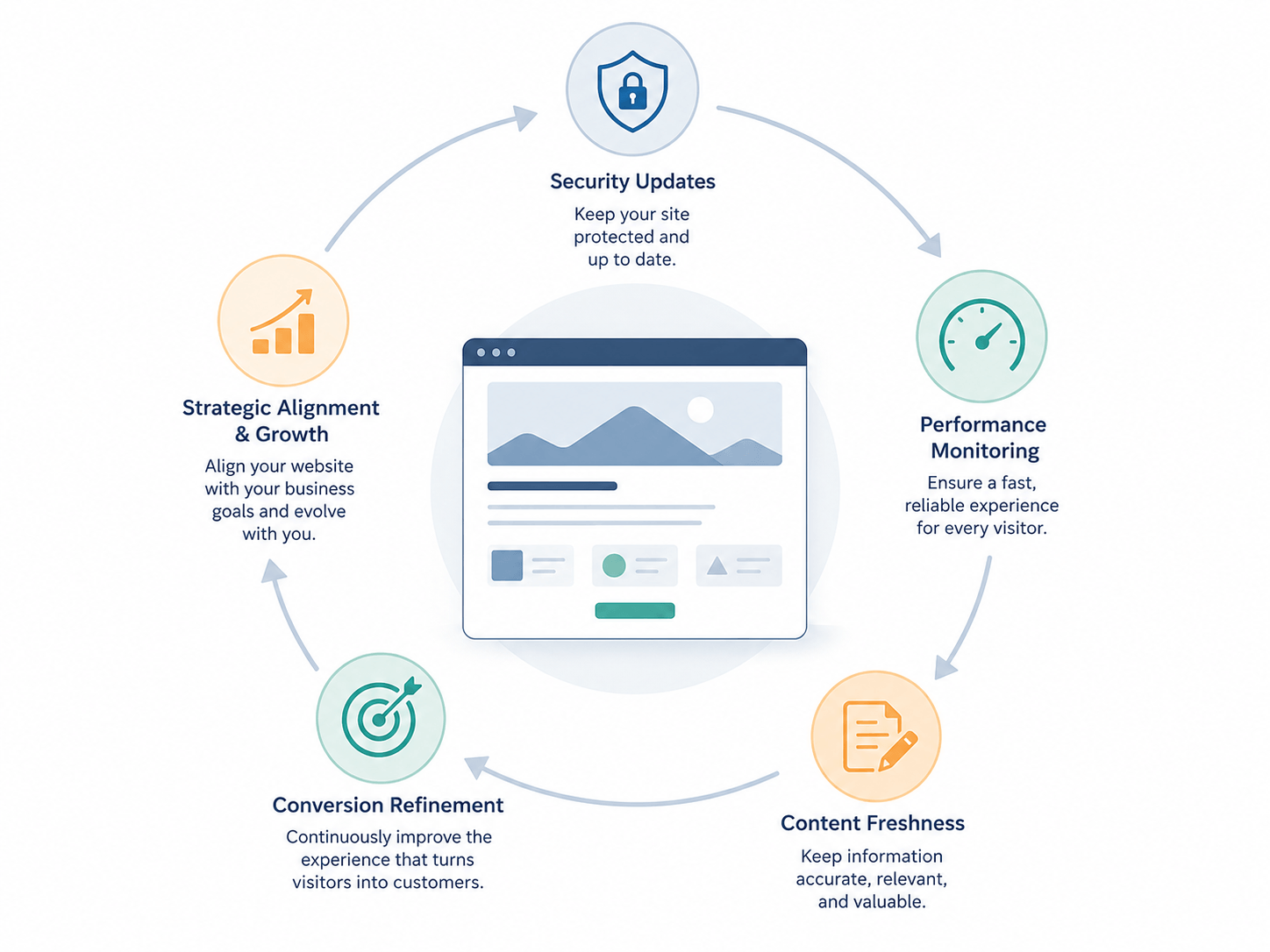
A website that isn’t actively maintained is a website whose security posture is drifting. Software updates, plugin patches, and platform security releases exist because vulnerabilities are discovered continuously, and a site that isn’t kept current is progressively more exposed to those vulnerabilities over time. This isn’t a theoretical risk for large enterprise targets. Small and mid-sized business websites are regularly targeted precisely because they are less likely to be actively maintained.
According to Google Search Central, sites flagged for security issues can be demoted or removed from search results entirely, meaning a security breach doesn’t just affect the site’s visitors, it affects the site’s ability to be found. The business impact of a hacked or flagged site compounds quickly: lost traffic, damaged credibility, and the cost of emergency recovery work that would have been far less expensive as routine prevention.
An ongoing web partnership treats security as a continuous responsibility rather than a launch-day checkbox. Updates are applied on a regular schedule. Vulnerabilities are monitored. Backups are maintained and tested. And if something does go wrong, there is someone already familiar with the site and accountable for its performance who can respond immediately rather than requiring discovery from a standing start.
Performance Requires Ongoing Attention
A website’s performance at launch is not a fixed quality. It changes over time and without active stewardship, it changes in the wrong direction.
New content is added without optimization. Third-party scripts accumulate as integrations are layered in. Hosting infrastructure ages relative to the improving baseline the broader web is moving toward. Google’s Core Web Vitals standards which measure loading performance, visual stability, and interactivity are an evolving benchmark, not a static one. A site that passed comfortably at launch may drift out of compliance as both the site itself and the standard it’s measured against continue to change.
The business consequences of performance degradation are direct and well-documented. Slower load times reduce conversion rates. Poor Core Web Vitals scores reduce search visibility. And the compounding effect of both, fewer visitors arriving and fewer of those visitors converting, is a gradual erosion of the site’s business value that happens without any single obvious trigger.
Keeping a website performing at a high level over time requires someone who is watching those metrics, understanding what they mean, and making adjustments before degradation becomes a problem rather than after it already is. This is a fundamentally different posture from the launch-and-leave model and it produces fundamentally different results. Our article on what a high-performing business website looks like in 2026 outlines the performance standards that an ongoing partnership is responsible for maintaining.
The Website Needs to Grow With the Business
A business that is standing still might be able to sustain a website that is standing still. Most businesses aren’t standing still and the gap between a growing business and a static website is one that widens steadily until it becomes a problem that requires a much larger intervention to fix.
Services change. New offerings need to be added and old ones updated or retired. The business’s positioning sharpens as it develops a clearer sense of who it serves best and what it does better than anyone else. The team grows. Client work produces results worth showcasing. The audience the business is trying to reach shifts as the business itself matures.
A website that can’t reflect these changes as they happen, because there is no one responsible for making them or because the site’s architecture doesn’t support them cleanly, will fall progressively further behind the business it’s supposed to represent. The credibility gap we describe in our article on why businesses look smaller online than they are is often the product of exactly this dynamic: not a bad website built for a bad business, but a good website built for an earlier version of a business that has since grown past it.
An ongoing web partnership keeps that gap from opening. It treats the website as a living document, one that is updated, refined, and expanded in step with the business rather than left behind while the business moves forward without it.
Strategic Continuity Is What Makes a Partner Different From a Vendor
The practical differences between an ongoing web partner and a one-time vendor such as the security maintenance, the performance monitoring, and the content updates, are meaningful. But the deeper difference is strategic.
A vendor who builds a website and moves on doesn’t carry any understanding of the business forward. The next time the business needs something, it has to start that relationship from scratch: explaining who they are, what they do, who their clients are, what they’ve tried before, what worked and what didn’t. Every new engagement begins at zero.
A long-term partner accumulates that understanding over time. They know the business’s positioning and can make decisions that reinforce it consistently. They understand the technical history of the site and can avoid the mistakes that history would make visible to anyone paying attention. They know what the business is trying to achieve, not just this month, but over the next several years and they can make recommendations that serve that trajectory rather than just the immediate request.
That accumulated understanding is genuinely valuable, and it is one of the things that a transactional vendor model structurally cannot provide. It requires continuity, a relationship that extends past the launch, past the first update, past the first problem that needs solving, and into the kind of sustained collaboration that produces better decisions and better outcomes over time.
This is also what separates a website investment that compounds from one that depreciates. As we explore in our guide on how to think about your website investment, the value a website generates is not fixed at launch, it grows or shrinks depending on the quality of the relationship and the attention behind it.
What to Look for in an Ongoing Web Partnership
Not every studio that offers ongoing support offers the same thing. The difference between a maintenance retainer that keeps the lights on and a genuine long-term partnership is worth understanding before a business makes that commitment.
A meaningful ongoing web partnership is proactive rather than reactive. It doesn’t wait for something to break before paying attention but rather it monitors performance, flags issues before they become problems, and brings ideas to the table rather than only responding to requests. It includes someone who understands the business well enough to make suggestions that are relevant to it specifically, not just technically sound in the abstract.
It also involves clear communication about what is being done and why. A business owner shouldn’t have to wonder whether their website is being maintained, they should have a clear picture of what attention it’s receiving, what the current state of its performance is, and what recommendations are on the table for the period ahead.
And it involves accountability. The right ongoing partner treats the website’s performance as their responsibility, not just their service area which means they care about the outcomes the site produces, not just the tasks they complete in relation to it. That orientation, toward results rather than deliverables, is the clearest signal that a studio is genuinely invested in the business’s success rather than simply its own continued engagement.

The Launch Is Where the Work Begins
The best web studios understand that launching a website is not the conclusion of a project. It is the moment when the project starts doing its job and when the real work of keeping it performing, growing, and aligned with the business begins.
A business that finds a studio with that orientation, one that is as invested in the site’s performance six months after launch as it was during the build, has found something worth holding onto. Not because switching vendors is complicated, but because the accumulated understanding that a long-term partner develops is genuinely difficult to replace and genuinely valuable to have.
The businesses that treat their website as a one-time purchase tend to find themselves back at the beginning every few years: explaining their business from scratch, addressing degradation that would have been caught earlier, and investing in fixes that a more continuous relationship would have made unnecessary. The businesses that treat it as an ongoing asset, one that deserves consistent attention and a partner invested in its performance, tend to find that the investment compounds. The site gets better over time, not worse. And the relationship behind it gets more valuable the longer it lasts.
Do you have a web partner who is as invested in your site’s performance today as they were the day it launched? If the answer is no or if you’re not sure, that gap is worth closing. Whether you’re looking for someone to take over an existing site, build something new with a long-term relationship in mind, or simply want to understand what genuine ongoing partnership looks like, let’s start that conversation.
Sources and Further Reading
Google Search Central — Manual Actions and Site Security
Google — Core Web Vitals Overview
Google Search Central — Understanding Page Experience
HubSpot — 2026 Marketing Statistics, Trends & Data