
There is a particular kind of frustration that comes with knowing your business is excellent and watching it go unrecognized.
You’ve done the work. You’ve built something real, a track record, a client base, a level of quality that people who’ve worked with you understand immediately. And yet when someone encounters your business for the first time online, something doesn’t land. The impression your website creates doesn’t match the business behind it. You look, in some hard-to-articulate way, smaller than you are.
This gap between actual quality and perceived quality is one of the most consequential and most overlooked problems in business development. It doesn’t show up as a line item on a report. It shows up as a prospect who visited your website and chose someone else, a referral that didn’t convert the way it should have, a first meeting where you sensed you were spending time re-establishing credibility that your online presence had quietly undermined.
Understanding why this happens and what actually closes the gap starts with understanding how perception works online.
Perception Forms Before You Get a Word In
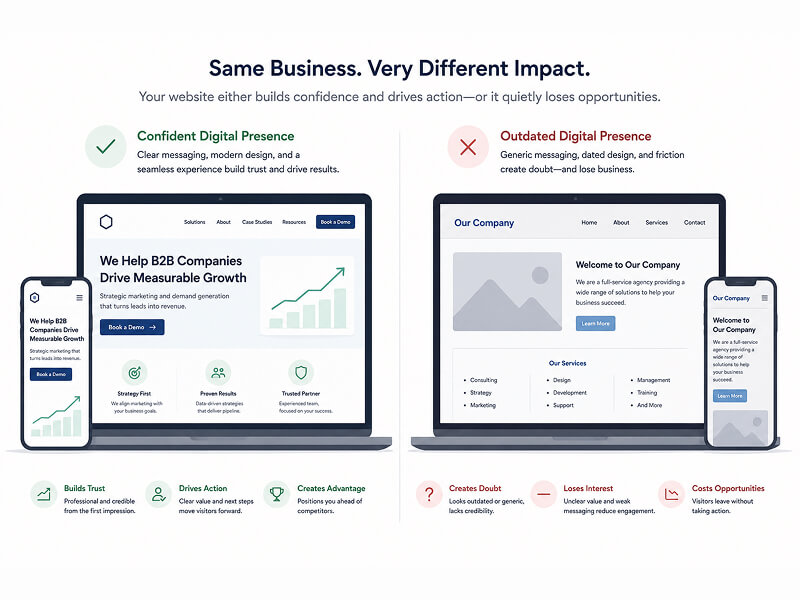
The first thing to understand is how little time a website has to establish credibility. Research from Google found that users form a visual impression of a website in approximately 50 milliseconds, a timeframe so brief it registers before conscious evaluation begins. By the time a visitor reads your headline, they have already formed a preliminary judgment about whether your business is worth their attention.
That judgment is based entirely on visual and experiential signals: design quality, layout clarity, load speed, and the overall feeling the site produces. None of those signals are explicitly about your capabilities or your track record. They are proxies and the human brain uses them as shortcuts to assess trustworthiness, competence, and scale.
A website that loads slowly, looks visually dated, or presents information in a cluttered or confusing way doesn’t just create a bad impression in isolation. It creates doubt that carries through the entire interaction. That doubt doesn’t disappear when the visitor reads your case studies or your client list. It reframes them. The visitor who arrived skeptical reads your credentials differently than the visitor who arrived with confidence in your caliber.
This is why design and performance aren’t aesthetic considerations for businesses that take their digital presence seriously. They are the first chapter of every client relationship that starts online, and first chapters determine whether people keep reading.
The Credibility Gap Is Usually Structural, Not Superficial
When businesses recognize that their website isn’t representing them well, the instinct is often to address surface-level symptoms: update the color palette, swap in new photos, refresh the copy. These changes can improve a site’s appearance, but they rarely close the credibility gap because the gap is usually structural, not cosmetic.
Structural credibility problems include sites built on platforms or templates that weren’t designed for the business’s actual requirements, information architectures that prioritize the business’s perspective over the visitor’s experience, conversion paths that are unclear or buried, and performance issues that create friction before a visitor has had a chance to engage with the content at all.
A cosmetic refresh applied to a structurally weak foundation produces a site that looks somewhat better but still doesn’t perform. The business still looks smaller than it is, just with a newer font.
Closing the credibility gap requires an honest assessment of whether the site’s foundation, specifically its platform, architecture, and strategic structure, is actually capable of representing the business at the level it requires. As we explore in our guide on choosing the right platform for your business, that assessment is often the most clarifying conversation a business can have about its digital presence.
What a High-Caliber Digital Presence Actually Communicates
It’s worth being specific about what a website that accurately represents an excellent business actually does because the answer is more precise than “it looks professional.”
A digital presence that matches the quality of the business behind it communicates several things simultaneously and without effort on the visitor’s part. It communicates that the business is established and stable. It communicates that the people behind it have high standards. It communicates that the visitor’s time and attention are respected through fast load times, clear navigation, and content that gets to the point. And it communicates that the business understands its own value, which is one of the most powerful trust signals a brand can project.
According to research compiled by HubSpot, 75 percent of consumers admit to making judgments about a company’s credibility based on its website design. That figure is worth sitting with. Three quarters of the people who visit your website are forming an opinion about whether your business is credible before they’ve spoken to anyone, before they’ve read a testimonial, before they’ve reviewed your portfolio. The website is the judgment, and everything else is context.
The businesses that understand this don’t treat their website as a brochure they update periodically. They treat it as a living representation of their standards and one that should be as considered and intentional as any other aspect of how they present themselves to the world.
Trust Signals Do More Work Than Most Businesses Give Them Credit For
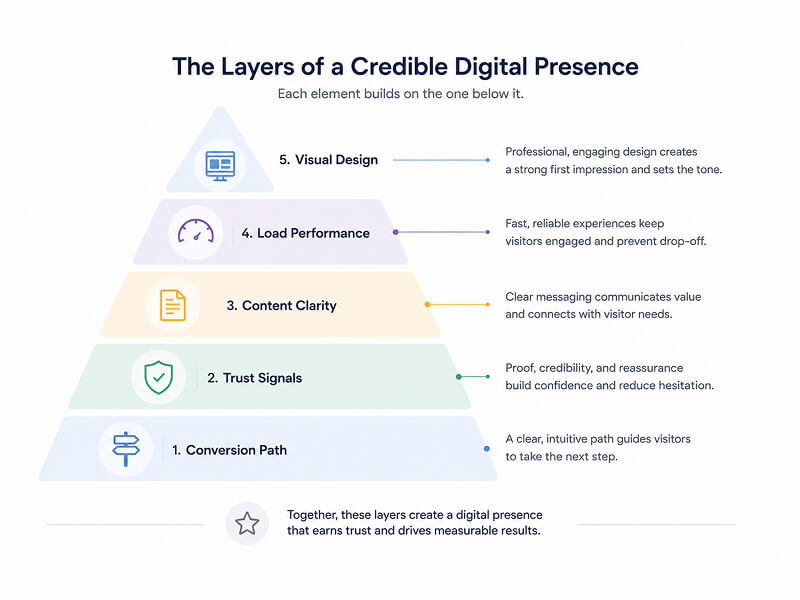
Beyond design and performance, the specific elements a website includes, or conspicuously omits, shape how a visitor calibrates their trust in the business.
Client testimonials, case studies, named results, industry recognitions, and clear demonstrations of expertise don’t just add polish to a website. They do the work of social proof by providing external validation that the business’s self-assessment is accurate. For a visitor who is evaluating multiple options, this validation is often what tips the scale.
Equally important are the signals that communicate security and professionalism at a technical level: SSL certificates, clean and modern design, absence of broken elements or outdated content, and hosting infrastructure that delivers consistent performance. These details are invisible when they’re right and damaging when they’re wrong. A visitor who encounters a security warning, a broken image, or a page that loads inconsistently doesn’t think “this business has a technical problem.” They think “this business isn’t detail-oriented” and that impression transfers directly to how they evaluate the business’s actual work.
We cover the full architecture of credibility signals in our guide on building website trust beyond social media icons, including which elements move the needle most and how to sequence them for maximum impact across the visitor journey.
Speed Is a Perception Problem as Much as a Technical One
Page load speed is typically discussed as a technical or SEO concern. But its impact on perceived business quality is just as significant and considerably more immediate.
A slow website doesn’t just frustrate visitors. It communicates something. It communicates that the business either doesn’t know its site is slow, doesn’t consider the visitor’s experience a priority, or hasn’t invested in the infrastructure required to deliver a professional digital experience. None of those impressions are ones an excellent business wants to make.
Research from Portent analyzing over 100 million page views found that sites loading in one second convert at nearly three times the rate of sites loading in five seconds. The performance gap isn’t marginal, it’s structural, and it compounds across every visitor the site receives.
Google reinforces this through its Core Web Vitals framework, which uses page experience signals as direct ranking factors. A slow site doesn’t just underperform with visitors but also ranks lower in search results, meaning fewer visitors ever reach it to begin with. The full business impact of this dynamic is covered in our article on website speed and conversions.
The Investment Signal
There is one more dimension to this worth naming directly: the quality of a website signals something about how a business values itself.
A business that has invested in a considered, well-built digital presence is implicitly communicating that it takes its own brand seriously. That signal is received by prospects, even if they couldn’t articulate it explicitly. It shapes the price sensitivity they bring to a conversation, the level of respect they extend before a relationship begins, and the confidence with which they refer the business to others.
Conversely, a website that clearly hasn’t been invested in, regardless of how good the actual work is, sends the opposite signal. It suggests a business that either doesn’t recognize the value of its own brand or hasn’t prioritized it. Neither reading helps in a competitive market.
As we outline in our guide on how much to invest in your website, the right investment level isn’t the smallest number that produces something acceptable. It’s the number that equips your most important business development asset to represent you at the level your business has earned.
Closing the Gap
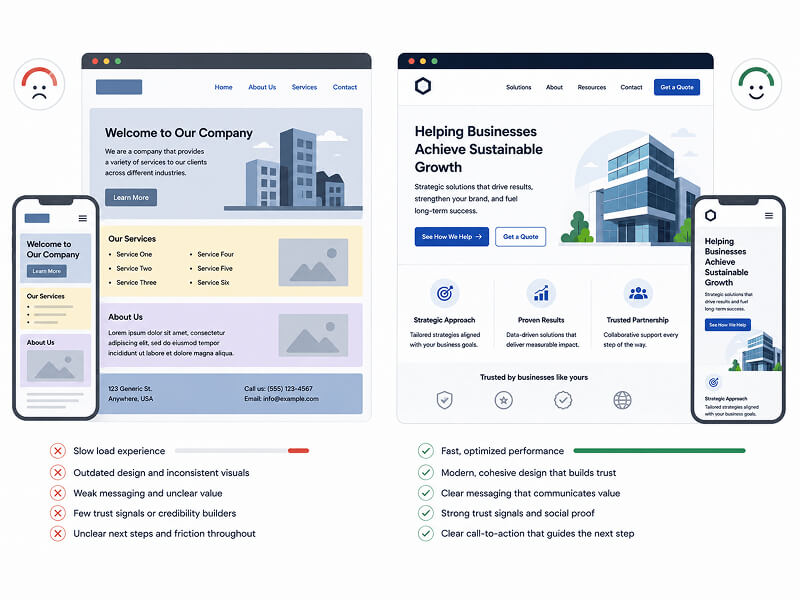
The businesses that look as good online as they are in person didn’t get there by accident. They made a deliberate decision to treat their digital presence as a direct reflection of their standards and they invested accordingly.
That decision doesn’t require a massive budget or a years-long project. It requires clarity about what the website is supposed to do, who it’s supposed to serve, and what level of quality is consistent with the business it represents. From that clarity, the right decisions about platform, design, performance, and content follow naturally.
The gap between how good your business is and how good it looks online is closeable. The businesses that close it don’t just look better, they convert better, refer better, and command the kind of immediate credibility that makes every subsequent business development conversation easier.
That’s the standard worth building toward.
Does your website reflect the business you’ve actually built or does it leave people with a smaller impression than you deserve? If there’s a gap between the quality of your work and the way your digital presence represents it, that gap has a cost measured in prospects who moved on, referrals that didn’t convert, and first impressions that required recovery. Whether you’re starting from scratch, reconsidering a site that no longer fits, or simply ready to close the distance between where you are and where your business should be presenting itself, let’s talk about what that looks like.
Sources and Further Reading
Google — The Need for Mobile Speed (Page Experience Research
Google — Core Web Vitals Overview
HubSpot — 2026 Marketing Statistics, Trends & Data
Portent — Site Speed Is (Still) Impacting Your Conversion Rate
Google Search Central — Understanding Page Experience