
There is no shortage of opinions about what makes a good website. Every year brings a new cycle of design trends, platform debates, and optimization frameworks with each one positioned as the thing that separates a website that performs from one that doesn’t.
But when you step back from the noise and look at the websites that consistently generate leads, build credibility on first contact, and earn the kind of trust that shortens sales cycles and strengthens referrals, a clear picture emerges. The fundamentals are more durable than the trends. And in 2026, those fundamentals are better understood, better measurable, and more consequential than they have ever been.
This is what a high-performing business website actually looks like, not as a checklist, but as a coherent standard worth building toward.

It Loads Fast Enough That Speed Is Never the Story
The first and most foundational characteristic of a high-performing website in 2026 is one the visitor never consciously notices: it loads quickly enough that speed simply isn’t a factor in the experience.
This matters more than most businesses realize. Research from Portent found that a site loading in one second converts at nearly three times the rate of one loading in five seconds. Google’s Core Web Vitals framework which measures loading performance, interactivity, and visual stability treats these metrics as direct search ranking factors. A site that fails Core Web Vitals isn’t just delivering a worse experience. It is being deprioritized in the search results that could be sending it qualified traffic.
A high-performing website in 2026 passes Core Web Vitals consistently, not just on a single audit. It loads in under two seconds on mobile across a range of connection speeds. Its images are optimized without quality loss. Its scripts load in an order that doesn’t block the rendering of the page. And its hosting infrastructure is chosen for performance, not just for price.
Speed at this level isn’t a technical achievement to celebrate internally. It is the invisible baseline that allows everything else on the site to be experienced at all. We cover the full business impact of page speed in our article on website speed and what it costs your business.
It Makes the Right Impression Before a Word Is Read
A high-performing website earns the visitor’s attention before they have consciously engaged with any of its content. The visual quality, the layout clarity, and the sense of intentionality the site projects in its first moments determine whether the visitor leans in or moves on, and that determination happens faster than rational evaluation can intervene.
In practice, this means a design that feels considered rather than assembled, typography that is readable and appropriately weighted, a visual hierarchy that guides the eye naturally toward the most important information, a color palette and imagery that communicate something specific about the business rather than simply filling space, and a consistency across every page that signals the business behind the site has standards and ensured that nothing was left to chance or expediency.
This level of design quality isn’t about following trends or achieving a particular aesthetic. It is about accurately representing the caliber of the business. A prospect who visits a site that looks excellent arrives at the first conversation with a baseline of trust already established. A prospect who visits a site that looks generic or dated arrives with questions the business then has to spend time answering. The difference in how those two conversations begin and how they tend to end is significant. We explore this dynamic in depth in our article on why businesses look smaller online than they are.
Its Messaging Is Structured Around the Visitor, Not the Business
One of the most consistent differences between websites that perform and websites that don’t is the order in which information is presented. Underperforming sites typically lead with the business: its name, its history, its services, its team. High-performing sites lead with the visitor: their situation, their goals, and the specific ways the business can help them achieve those goals.
This isn’t a copywriting trick. It reflects a genuine understanding of how decisions are made online. A visitor who lands on a website is asking, usually within the first few seconds, whether this is relevant to them. A site that answers that question immediately, thereby making the visitor feel seen and understood before it asks them to be interested in the business, earns the right to go deeper. A site that leads with the business’s perspective requires the visitor to do work before the conversation has even begun.
High-performing websites in 2026 open with headlines that speak to the visitor’s reality. Their about pages tell a story that’s relevant to the client, not just flattering to the company. Their service descriptions are written around outcomes the client cares about, not processes the business is proud of. And their content, every page and every section, is organized around the question: what does this visitor need to know right now, and what do they need to feel confident enough to take the next step?
Every Page Has a Clear and Singular Next Step
A high-performing website never leaves a visitor wondering what to do. Every page, the homepage, the service pages, the about page, the blog has a clear, intentional next step that aligns with where that visitor is likely to be in their decision-making process.
This doesn’t mean every page ends with a hard sell. A visitor reading an educational article is probably not ready to request a proposal. But they may be ready to read another article, subscribe to a newsletter, or explore a related service page. A visitor on a service page who has already done their research probably is ready to reach out, and the path to doing so should require as little effort as possible.
The architecture of a high-performing website reflects a clear understanding of the visitor journey and removes friction at every point along it. Contact forms are accessible without multiple clicks. Phone numbers and email addresses are visible without hunting. Calls to action are specific rather than generic, not just “Contact Us” but a phrase that reflects the value of the conversation being offered. And the entire path from first impression to first inquiry is as short and frictionless as the business’s service model allows.
The relationship between this kind of intentional conversion architecture and actual lead generation is direct and well-documented. Our article on why websites fail to generate leads breaks down how conversion path clarity, or the lack of it, affects outcomes across every stage of the visitor journey.
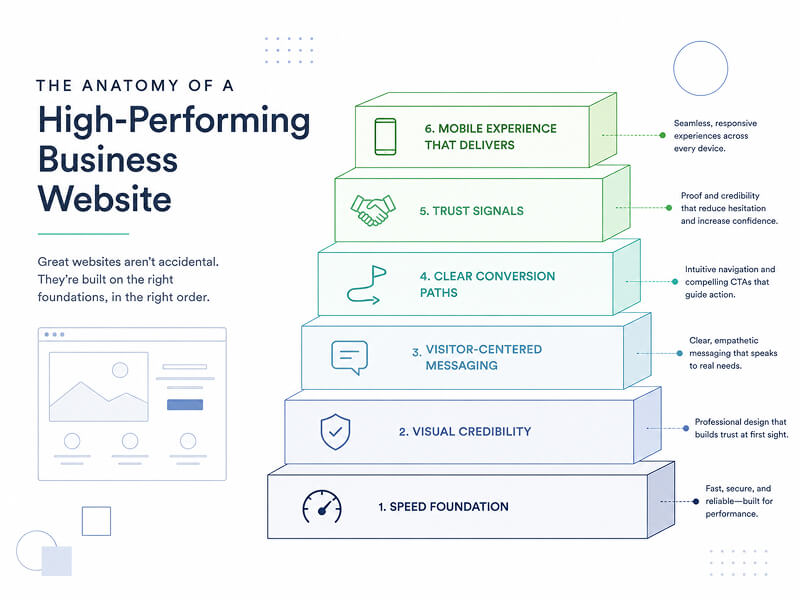
It Projects Credibility Through Every Detail
Trust is not communicated through a single element on a website. It is the cumulative impression created by dozens of details, some significant while some subtle, that together signal to a visitor whether this business is what it says it is.
On a high-performing website, those details are right. Client testimonials are specific and attributed, not generic and anonymous. Case studies describe real outcomes in concrete terms. The team section, if present, shows real people with real credentials rather than stock photography and placeholder bios. SSL security is current. The copyright date in the footer is accurate. Every link works. Every image loads.
According to research compiled by HubSpot, 75 percent of consumers assess a company’s credibility based on its website design. That assessment happens across all of these details simultaneously which means that a single broken element or a single piece of content that feels outdated can undermine the impression created by everything else on the site.
High-performing websites treat credibility as a system rather than a feature. Every element is considered. Every detail is maintained. And the overall impression the site creates is one of a business that holds itself to a high standard, which is the most powerful implicit argument any website can make for the quality of the work behind it. Our guide on building website trust signals that actually work covers the full architecture of credibility in practical terms.
It Performs Equally Well on Every Device
In 2026, mobile performance is not an enhancement but rather a baseline requirement. Google Search Central uses mobile-first indexing as its standard, meaning the mobile version of a website is the version Google evaluates for ranking purposes. A site that performs beautifully on desktop but delivers a degraded experience on mobile is being evaluated and ranked primarily on its weakest version.
But mobile performance on a high-performing website goes beyond responsive design. It means that every interaction every tap target, every form field, every piece of navigation is designed with the mobile experience in mind from the beginning, not adapted from a desktop layout as an afterthought. It means that load times on mobile meet the same standard as on desktop, which requires deliberate optimization rather than simply the absence of desktop-only elements. And it means that the visual quality and clarity the site achieves on a large screen translates fully to a phone because that is where a significant portion of first impressions now happen.
It Is Built on a Foundation Designed to Last
A high-performing website in 2026 is not just performing well today. It is built on a foundation that will continue to perform as the business grows, as its needs evolve, and as the technical landscape shifts around it.
This means the platform was chosen for the business’s specific requirements such as its content model, its performance needs, its team’s ability to manage it, rather than for convenience or familiarity. It means the codebase is clean enough that updates don’t create new problems. It means the site’s architecture can accommodate new services, new content, and new functionality without requiring the kind of patching and workaround accumulation that eventually forces a rebuild.
As we explore in our guide on choosing the right platform for your business, the right foundation is the one that fits the business and not the one that is most popular or most familiar. A site built on the right foundation doesn’t require replacement every few years. It requires maintenance, refinement, and occasional expansion which is the appropriate relationship between a serious business and its most important digital asset.
When that relationship breaks down or when the foundation can no longer support what the business needs, then the indicators are usually clear, as we outline in our article on when it’s time to stop patching and start over. The businesses that recognize those indicators early and act on them deliberately are the ones whose websites consistently outperform because they treat the foundation as seriously as they treat everything built on top of it.

The Standard Worth Building Toward
None of what a high-performing website requires in 2026 is new in principle. Speed, clarity, credibility, and a genuine understanding of the visitor’s experience have always been the foundations of a website that works. What has changed is the precision with which these qualities can be measured, the directness with which they affect business outcomes, and the gap, now quite visible, between websites built to this standard and those that are not.
The businesses whose websites meet this standard don’t just look better online. They convert more consistently, build trust faster, and create the kind of first impression that makes every subsequent business development conversation easier. Their website is working as a genuine asset, one that compounds in value over time as it continues to perform, generate relationships, and represent the business at the level it has earned.
That is the standard. And it is entirely achievable for any business willing to approach its digital presence with the same seriousness it brings to everything else it does well.
Does your website meet this standard — or is there a gap between where it is and where it should be? Whether you’re starting from scratch, reassessing a site that has run its course, or simply ready to build something that performs at the level your business deserves, the right foundation makes all the difference. Let’s talk about what that looks like for your business.
Sources and Further Reading
Portent — Site Speed Is (Still) Impacting Your Conversion Rate
Google — Core Web Vitals Overview
Google Search Central — Mobile-First Indexing Best Practices
HubSpot — 2026 Marketing Statistics, Trends & Data
Google Search Central — Understanding Page Experience