
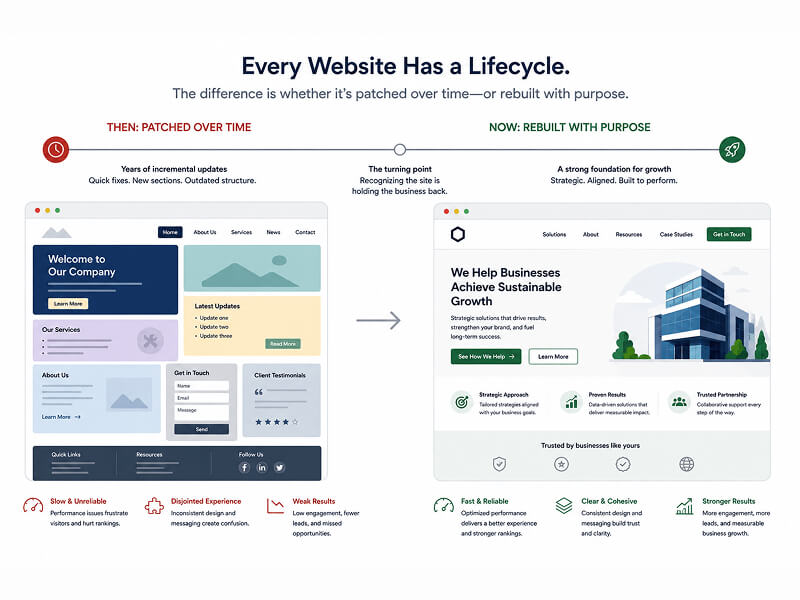
Most businesses don’t wake up one day and decide their website needs a complete rebuild. It happens more gradually than that. A feature gets added to address a new need. A plugin fills a gap. A section gets redesigned without touching the rest. A developer makes a fix that requires two more fixes down the line. And at some point, without a single dramatic moment to point to, the site has become something nobody fully understands, built on decisions that made sense at the time but no longer serve the business as it exists today.
The patching approach feels responsible. It feels like good stewardship, working with what you have, making incremental improvements, avoiding the disruption of a full rebuild. And for a while, it is. But there is a point past which patching stops being pragmatic and starts being costly. The site becomes harder to maintain, slower to load, more difficult to update, and less capable of performing the business function it was built to serve.
Recognizing that point, clearly and without either panic or denial, is one of the more valuable things a business owner can do for their digital presence. Here is how to read the signs.
The Site Has Been Modified Past Its Original Design
Every website is built with a particular architecture in mind, a set of assumptions about how content will be structured, how pages will relate to each other, and how the underlying platform will be used. When those assumptions are correct and the site stays within them, maintenance is manageable and performance holds.
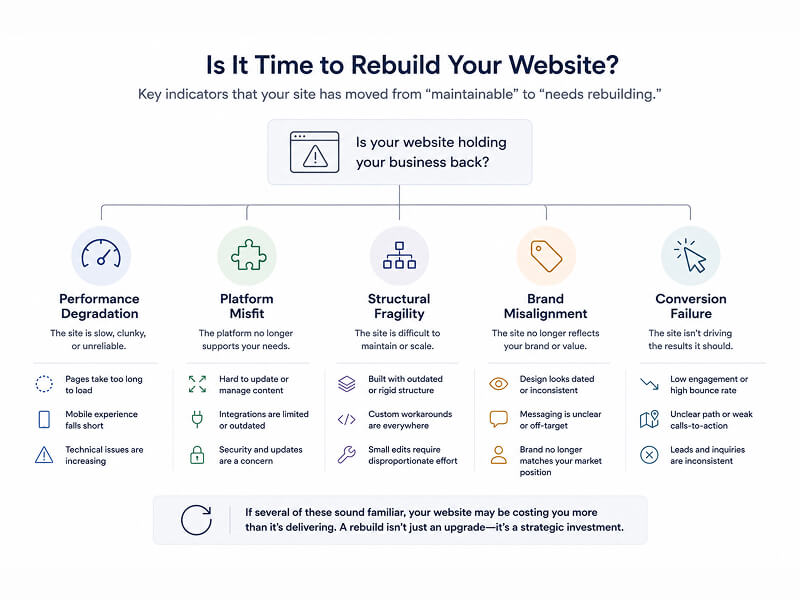
The problems begin when the business outgrows those assumptions. New services get added to a navigation that wasn’t designed for them. A blog gets bolted onto a site that wasn’t built to support one. An e-commerce function gets layered onto a platform that was originally chosen for a portfolio. Each addition works in isolation but creates compounding complexity that eventually makes the site fragile, inconsistent, and difficult for anyone, including the people who built it, to manage confidently.
If updating your website requires a developer briefing that starts with “be careful around that section,” or if adding something new to the site consistently breaks something else, the architecture has been stretched past its limits. That’s not a maintenance problem. That’s a foundation problem, and it responds to foundation-level solutions.
Performance Has Become a Persistent Issue
A website that loads slowly is a website that is losing business, not occasionally, but consistently, across every visitor it receives. Research from Portent found that sites loading in one second convert at nearly three times the rate of sites loading in five seconds. Every second of additional load time represents a measurable and compounding loss.
For many websites that have been patched and extended over time, performance degradation is structural rather than fixable with optimization alone. The cumulative weight of plugins, scripts, unoptimized assets, and legacy code creates load burdens that surface-level fixes can reduce but rarely resolve. Compressing images and enabling caching can improve a site’s score on a performance audit. They cannot rebuild an architecture that was never designed for the performance standards a modern business website requires.
Google’s Core Web Vitals framework makes this consequential beyond the user experience level. Page experience signals are direct ranking factors which means a persistently slow site isn’t just converting poorly, it’s also becoming harder for new prospects to find. We cover this dynamic and its full business impact in our article on website speed and what it costs your business.
The Platform No Longer Fits the Business
Platform fit is one of the most consequential and least discussed aspects of website strategy. The platform a business chooses determines what is possible, what is practical, and what requires workarounds, and a platform that was the right fit for a business at one stage of its development may become a constraint at another.
A business that started with a simple template site and has since grown its service offering, its team, and its client base may find that its platform can’t support the content architecture, the performance requirements, or the integration needs of the business it has become. The workarounds accumulate. The limitations become more visible. And the cost of maintaining a site that is fighting against its own platform begins to exceed the cost of rebuilding on a foundation that actually fits.
This isn’t a universal argument for any particular platform or approach. The right foundation depends entirely on the business’s specific requirements, its content model, its performance needs, its team’s technical capacity, and its growth trajectory. As we explore in our guide on choosing between WordPress and custom development, the most important question isn’t which platform is best in the abstract. It’s which platform is best for this business, right now, and over the next several years.
The Site No Longer Reflects the Business
A website that was built for the business you were three years ago may not accurately represent the business you are today. The services have evolved. The positioning has sharpened. The client profile has changed. The quality of the work has grown. And the site, built to communicate a different version of the business to a different audience, is quietly creating a credibility gap that affects every first impression it makes.
This misalignment is subtler than a performance issue but no less costly. A prospect who visits a website that feels dated, generic, or misaligned with the business’s actual positioning doesn’t necessarily leave with a clear objection. They leave with a vague sense that something didn’t quite fit and that feeling shapes whether they reach out, whether they take the business seriously as a candidate, and what price expectations they bring to the conversation if they do.
As we outline in our article on why businesses look smaller online than they are, the gap between a business’s actual caliber and its digital representation has a measurable impact on credibility, conversion, and the quality of relationships the business is able to begin. A site that no longer reflects what the business has become isn’t just aesthetically misaligned, it’s strategically working against the business.
Optimization Has Stopped Producing Returns
There is a reliable signal that a website has reached the end of what patching can accomplish: optimization efforts stop moving the needle.
A site in this condition will often show modest improvements from individual fixes, such as a slightly better performance score or a marginally improved bounce rate, without producing meaningful changes in the metrics that matter: leads generated, inquiries received, conversions completed. The fixes are real, but the foundation they’re applied to can’t translate them into business results.
This is the point at which the conversation shifts from “how do we improve what we have” to “what would we build if we were starting with what we know now?” That question, answered honestly, is usually the clearest possible brief for a rebuild. It surfaces the strategic decisions that should have been made earlier, the structural choices that would have been made differently, and the foundation that the business actually needs to perform at the level it’s capable of.
If your website isn’t generating the leads and inquiries your business should be attracting, our article on why websites fail to generate leads breaks down the structural, messaging, and performance factors that are most often responsible, and what addressing them actually requires.
The Cost of Waiting
One of the more counterintuitive aspects of the patch-versus-rebuild decision is the cost calculus. The rebuild feels expensive because it is a defined, visible investment. The ongoing cost of a site that underperforms is diffuse and invisible, spread across lost leads, weakened first impressions, developer hours spent on fragile maintenance, and the compounding opportunity cost of a business development asset that isn’t doing its job.
When those costs are made explicit, the math often shifts significantly. A website that generates one additional qualified lead per month, at an average client value of several thousand dollars, pays for a significant rebuild investment within a relatively short period. A website that fails to convert prospects who would otherwise have been strong fits represents a loss that accumulates quietly and indefinitely.
Our guide on how to think about your website investment frames this calculation in practical terms and not as a pitch for spending more, but as a framework for understanding what a website is actually worth to a business and what the cost of underinvestment actually looks like over time.
Making the Decision Clearly
The decision to rebuild a website doesn’t have to be dramatic. It doesn’t require a crisis or a catastrophic failure. It requires honest answers to a small set of practical questions.
Is the site performing at the level the business requires in speed, in conversion, in the quality of impressions it creates? Is the platform capable of supporting the business’s needs over the next several years without compounding workarounds? Does the site reflect the business as it actually exists today, in its positioning, its quality, and the audience it is trying to reach? And has optimization reached the point of diminishing returns, where fixes improve metrics without improving outcomes?
If the honest answer to most of those questions is no, the more pragmatic decision is usually a rebuild, not because patching is wrong in principle, but because there is a point past which patching is the more expensive option, and most businesses that have reached it already sense that they have.
The clarity that comes from that honest assessment is the starting point for building something that actually fits, a foundation designed for the business as it is, not the business as it was.
Is your website still serving your business or has it become something you’re managing around? If updates feel risky, performance has plateaued, or the site simply no longer reflects what your business has become, the question usually isn’t whether to rebuild but rather it’s when and how to do it right. Whether you’re ready to make that call or still working through what the right move is, let’s have an honest conversation about what your website actually needs.