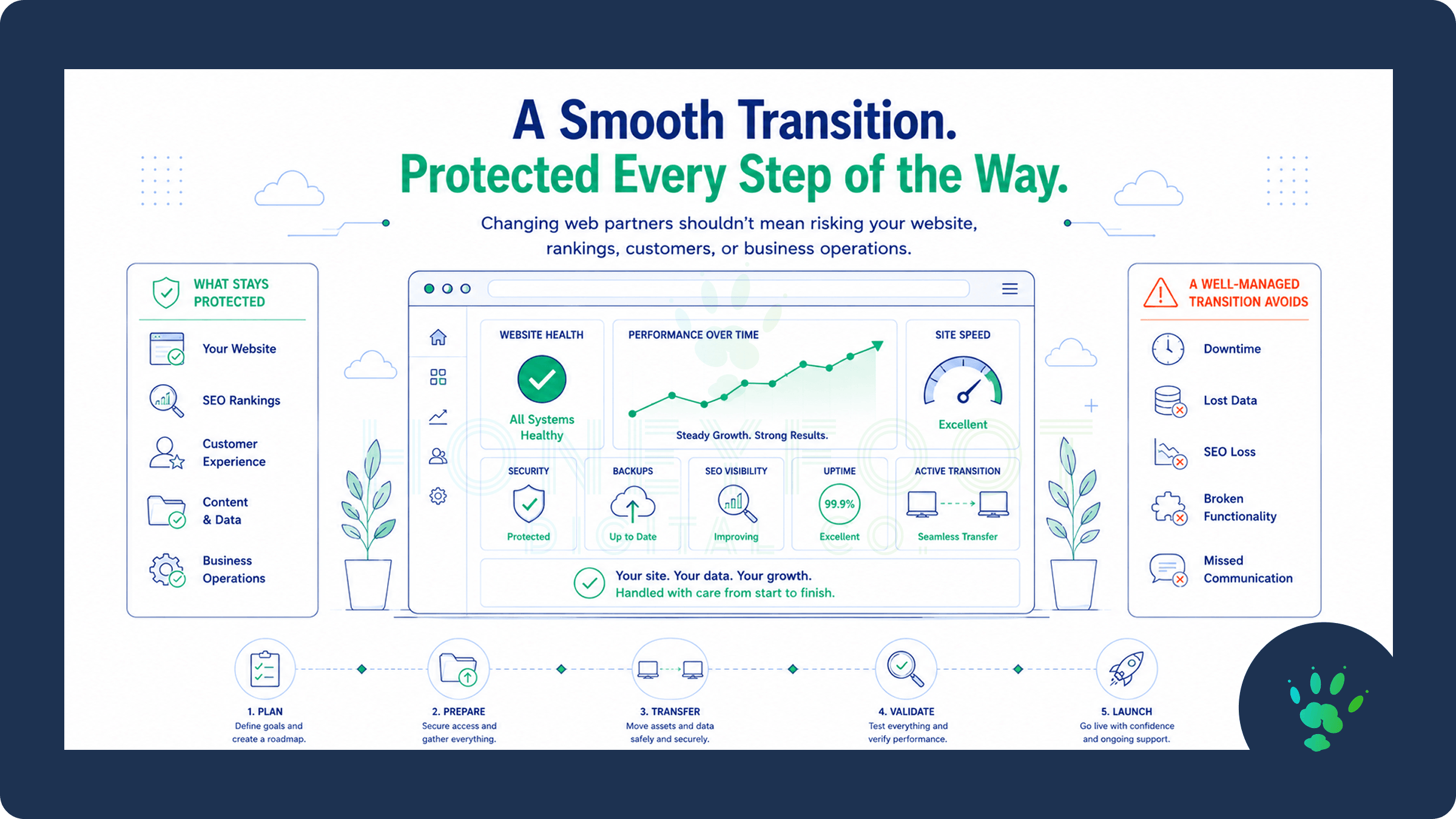
What Actually Happens During a Transition, and What Doesn't Have To
The single biggest reason business owners stay in a web relationship long after they've stopped getting real value from it isn't loyalty, and it isn't even inertia. It's fear, specifically the fear that switching will break something. Downtime. Lost content. A vanished search ranking that took years to earn. A domain that somehow gets stuck in limbo. None of these fears are irrational. They're just, in a properly managed transition, largely avoidable.
This fear tends to grow the longer a relationship goes on, which creates a strange dynamic: the businesses most overdue for a change are often the ones who feel most locked in, simply because more time has passed and more feels like it's riding on the current arrangement staying intact. The passage of time doesn't actually increase the technical risk of switching. It just increases how large that risk feels.
Understanding what a switch actually involves, what's genuinely at risk, what's overstated, and what a professional transition looks like in practice, removes most of the reason to stay somewhere that isn't serving the business anymore.
The Fear Is Reasonable. The Risk Is Usually Overstated.
It's worth naming the fear honestly before addressing it, because dismissing it outright doesn't help anyone make a good decision. A website is not a side project: for most small and mid-sized businesses, it's a primary source of leads, credibility, and first impressions. The idea of touching it, let alone handing it to someone new, understandably feels risky.
But the actual failure points in a transition are well understood and, with the right preparation, straightforward to avoid. Almost every horror story about a “botched migration” traces back to the same handful of preventable mistakes: no backup taken before changes were made, no plan for redirects, DNS changes made without a rollback plan, or a rushed cutover attempted with no testing period. None of these are inherent risks of switching. They're the risks of switching carelessly.
What to Gather Before Starting the Conversation
A business owner doesn't need to have every technical answer figured out before reaching out to a new partner. That's the new partner's job to help sort out. But having a few things gathered in advance makes the whole process faster and safer, and it also protects the business regardless of which partner ends up handling the transition.
Domain registrar access. Knowing where the domain is registered and having login access (or knowing who has it) avoids one of the most common early snags in any transition. A surprising number of small business domains are registered under a previous vendor's account rather than the business owner's own, which can turn a simple handoff into a longer negotiation if it isn't resolved early.
Hosting and CMS credentials. Access to the current hosting account and content management system, even if the current partner ultimately handles the technical handoff, gives the business owner leverage and visibility rather than dependency.
A content inventory. A general sense of what pages, blog posts, and assets exist on the current site. This doesn't need to be exhaustive, since a new partner will do a proper audit, but knowing roughly what's there helps catch anything that goes missing.
Analytics and Search Console access. These accounts belong to the business, not the vendor, and should never be locked inside a relationship that's ending. If access to these currently sits entirely with the outgoing partner, that's worth resolving early.
A record of any existing licenses or subscriptions. Premium themes, plugins, or third-party tools tied to the current site are worth identifying ahead of time, since some are licensed to the business and others may be licensed to the outgoing vendor, a distinction that matters once the relationship ends.
How a Professional Transition Actually Works
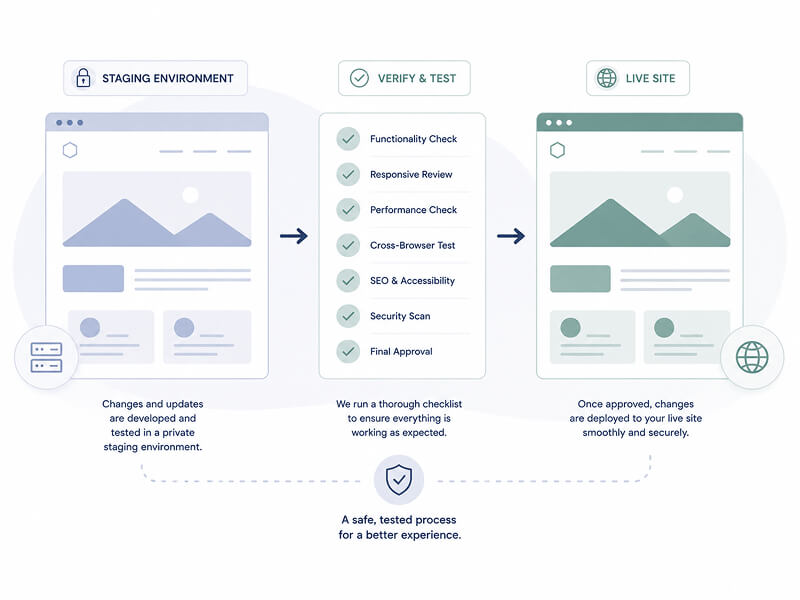
A well-run switch doesn't happen all at once, and it doesn't happen live on the production site. It typically follows a staged process: the new site or platform is built and tested in a private, non-public environment first, changes are verified thoroughly, and only once everything checks out does the actual cutover happen, often during a low-traffic window, and often completed within minutes rather than hours.
This is the part that surprises most business owners: the moment of highest anxiety, flipping the switch, is usually the shortest and least eventful part of the entire process. The real work happens beforehand, in preparation and testing, precisely so that the visible transition is as uneventful as possible.
Protecting the SEO Equity Already Earned
This is often the single biggest source of anxiety, and it deserves a direct answer: rankings built over time do not have to be lost in a well-executed switch. The mechanism that protects this is a permanent redirect, commonly called a 301 redirect, which tells search engines that a page has moved and passes its established authority to the new location. According to Google Search Central's own documentation, permanent redirects do not cause a loss in the ranking signals a page has accumulated, provided they're implemented correctly and every meaningful URL is accounted for.
The operative phrase there is “implemented correctly.” A rushed or incomplete redirect map, where some old URLs are mapped and others are simply left to break, is where ranking losses actually happen, and it's a preparation failure, not an inherent cost of switching. A new partner worth working with will treat this step as non-negotiable, not optional.
It's also worth setting a realistic expectation around timing rather than perfection: some temporary fluctuation in rankings during the reprocessing window is normal and expected, even in a well-executed switch, simply because search engines need time to re-crawl and re-index the moved content. The distinction that matters is between a brief, expected adjustment period and a genuine, lasting loss. The former is routine. The latter is the result of skipped preparation.
What Should Not Change on Day One
One of the most reassuring things about a properly managed switch is how little actually has to change from a visitor's perspective on the day it happens. The domain typically stays the same. Existing page URLs, where possible, stay the same. Email addresses tied to the domain continue working without interruption when handled correctly. The site a customer visited yesterday should look, at minimum, familiar, and ideally simply better, the day after a switch, not unrecognizable or, worse, broken.
Business continuity during a transition isn't a lucky outcome. It's the actual goal of a competent process, and it's reasonable to ask any prospective new partner directly how they plan to protect it.
Switching Doesn't Have to Mean Starting Over
One misconception worth addressing directly: choosing a new partner doesn't automatically mean the entire website gets scrapped and rebuilt from scratch. In many cases, a new partner can take over an existing, functioning site as-is, managing it, improving it incrementally, and only rebuilding what genuinely needs rebuilding, rather than treating the switch as an excuse for a full teardown.
Whether a full rebuild makes sense is a separate question from whether it's time for a new partner, and a good new partner should be willing to have that conversation honestly rather than defaulting to “rebuild everything” simply because it's the larger, more profitable engagement. Sometimes the right first move after a switch is nothing more than better ongoing management of what already exists.
Setting a Realistic Timeline
Expectations about timing matter as much as expectations about risk. A straightforward handoff, new hosting, new point of contact, no platform change, can often happen within days. A full migration to a new platform, especially for a larger or more complex site, reasonably takes several weeks once the necessary preparation, testing, and redirect mapping are accounted for. Neither timeline requires the business to go dark or operate without a website at any point in between.
It's worth being wary of any timeline that sounds too aggressive relative to the size of the site, since a rushed transition is where corners get cut on exactly the preparation steps that make a switch safe in the first place. A new partner who gives a realistic, slightly longer timeline with a clear testing period is generally more trustworthy than one promising an overnight turnaround.
The Conversation That Should Happen Before Anything Moves
A trustworthy new partner will walk through the transition plan before any part of it begins: what gets backed up, in what order changes happen, what the testing period looks like, and what the rollback plan is if something doesn't go as expected. If a prospective partner can't clearly answer what happens if something goes wrong mid-transition, that's worth treating as a signal, not a technicality to skip past.
This conversation is also where a business owner gets a preview of what an ongoing relationship with this new partner might actually feel like. A studio that handles the handoff with clear communication and a documented plan is very likely the same studio that will bring that same rigor to the ongoing partnership that follows. A studio that's vague or dismissive about transition risk is unlikely to suddenly become more careful once the relationship is underway.
You Don't Need All the Answers to Start
Perhaps the most freeing realization in all of this is that a business owner doesn't need a fully resolved technical plan before reaching out. The point of an initial conversation, the kind covered in what a real strategy session actually looks like, is precisely to work through these questions with someone who does this for a living. Waiting until every detail feels resolved is often just another version of staying somewhere that isn't serving the business anymore, simply because the alternative feels unknown.
The businesses that make this transition well aren't the ones with the most technical expertise going in. They're the ones who stopped treating the fear of switching as a permanent reason not to. The relationship that's underperforming today will still be underperforming next year if the only thing standing between the business and a better one is the discomfort of a conversation.
What's actually keeping your business tied to a web relationship that isn't working: the arrangement itself, or the fear of what switching might involve? Whether you're already convinced it's time for a change or simply want to understand what a transition would actually look like before deciding anything, that conversation doesn't require commitment. Let's walk through what switching would actually involve for your business.
Sources and Further Reading
Google Search Central: Site Moves and Migrations