
Most business owners never actually evaluate the relationship. They evaluate the invoice, or the response time on the last support request, or the simple fact that the website is still up and functioning. What they rarely do, because there's no natural prompt to do it, is step back and ask whether the arrangement itself is serving the business the way a real partnership should.
That question is worth asking periodically, and not only when something has visibly gone wrong. The gap between a genuine web partner and one that's merely adequate rarely announces itself as a single dramatic failure. It shows up as a slow accumulation of things that didn't happen: the redesign conversation that never got initiated, the security update applied a version late, the strategic question that went unasked because no one was actually looking at the site with the business's trajectory in mind. None of that shows up on an invoice. All of it shows up in results, eventually.
Here is what separates a genuine partner from a vendor who simply keeps the lights on.

Responsiveness Is Not the Same as Partnership
The most common mistake business owners make when evaluating a web relationship is mistaking responsiveness for partnership. A vendor who answers emails quickly and fixes what's broken feels, on the surface, like a good relationship. And to be fair, baseline responsiveness matters, a partner who goes dark for weeks at a time is failing at something fundamental.
But responsiveness is table stakes, not the standard. It measures whether someone shows up when asked. It says nothing about whether they're thinking about the business when they're not being asked, which is where the actual value of a long-term partnership lives. A vendor fixes what's broken. A partner notices what's about to break, or what's quietly underperforming, before it becomes a problem the business owner has to raise first.
This distinction matters because it's easy to feel satisfied with a relationship that's simply not causing active friction, while still leaving considerable value on the table. Comfortable and optimal are not the same thing, and the businesses that get the most out of their websites tend to be the ones that recognize the difference.
What They Do Without Being Asked
One of the clearest signals of genuine partnership is what happens between requests. Does the relationship only move when the business owner initiates it, such as a new feature, a fix, a question, or does the other side bring things forward unprompted?
A studio that's actually paying attention will flag a page that's underperforming before being asked to look into it. It will mention when a plugin or platform update introduces new risk. It will notice when the business has clearly evolved, perhaps with new services, a new market, a shift in positioning, and raise the question of whether the site still reflects that. This is the difference between a website being maintained and a website being managed, and it's a distinction worth paying close attention to when evaluating what a genuine partnership should include.
If every improvement to the site over the past year originated from the business owner's side of the table, that's worth noticing. It doesn't necessarily mean the relationship is failing, but it does mean the business is doing the strategic thinking that should, at least in part, be coming from the partner.
How They Talk About What's Not Working
Every website has something that could be better. The way a web partner discusses those gaps says more about the relationship than almost anything else.
A vendor optimized for keeping the relationship comfortable will tend to agree with whatever the business owner already believes, avoid raising uncomfortable truths, and frame every conversation in a way that keeps the current arrangement intact. A genuine partner will be willing to say that a page isn't converting the way it should, that a platform choice made years ago is now holding the business back, or that a proposed change isn't actually going to solve the underlying problem.
Honest counsel is uncomfortable in the short term and valuable in the long term. It's also one of the hardest things to manufacture in a vendor relationship, because it requires a level of investment in the business's actual outcome, not just the continuation of the contract. When evaluating a current arrangement, it's worth asking honestly: has this partner ever told me something I didn't want to hear, and was it right?
Whether the Relationship Has Compounded or Stalled
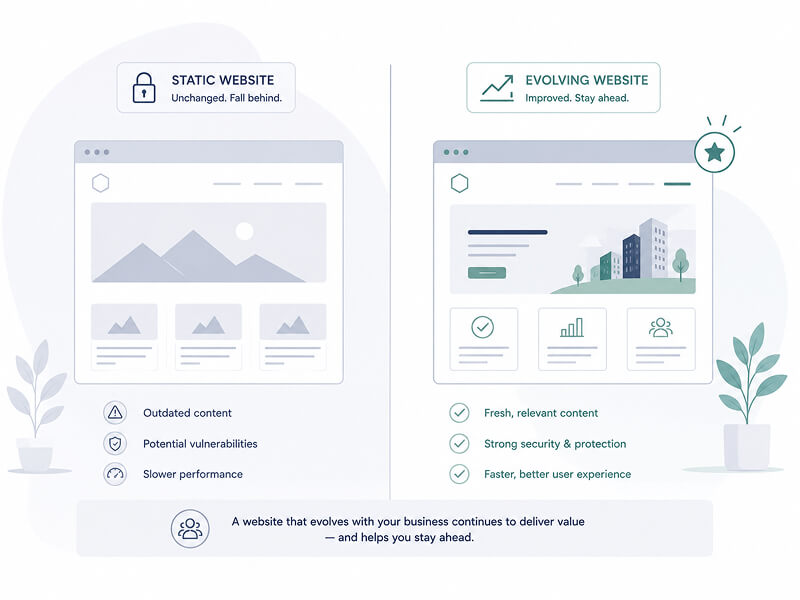
A website is not a static asset nor should it be treated as one. It should get better over time: faster, more aligned with how the business actually operates, more capable of converting the traffic it receives. Understanding what a high-performing website actually looks like gives a useful benchmark for this, not as a one-time bar to clear at launch, but as an ongoing standard the site should continue to meet as it evolves.
The test worth applying here is simple: is the website meaningfully better today than it was a year ago, in ways that go beyond routine software updates? Or has it essentially stayed the same, technically current but strategically frozen? A relationship that compounds produces a site that keeps closing the gap between what the business is capable of and what its digital presence communicates. A relationship that's stalled produces a site that's merely being kept alive.
This is also where it's worth revisiting what a real maintenance plan should include because a plan that covers backups, updates, and uptime but stops there is providing insurance, not partnership. Insurance prevents loss. Partnership creates gain. Both matter, but they are not the same service, and it's reasonable to expect both from an arrangement that's being paid for as an ongoing relationship rather than a one-time build.
Whether the Relationship Understands the Business, or Just the Website
There's a meaningful difference between a partner who knows a business's codebase and one who knows the business itself. The first can tell you what plugin is installed and when it was last updated. The second can tell you why a particular page matters more than the others, which service line is growing, and how the site should evolve to support that growth before being told to.
This distinction becomes obvious the moment a business shifts direction. A partner who understands the business will proactively ask how a new offering, a new hire, or a new market should be reflected online. A vendor who only knows the technical footprint will wait for a ticket. Neither approach necessarily reflects bad intentions, but only one of them treats the website as connected to what the business is actually trying to accomplish, rather than as a standalone piece of software to be kept running.
It's worth asking, honestly, how much of the current arrangement's knowledge is technical versus strategic. A partner who could describe the business's goals as clearly as its site architecture is operating at a different level than one who couldn't.
Reading the Relationship's Trajectory
Beyond any single interaction, it's worth stepping back and looking at trajectory. Early in most vendor relationships, there's a natural period of attentiveness typically during the initial build, the first few months of adjustments, the honeymoon period where responsiveness is high because the relationship is new. The real test of partnership is what happens after that period ends.
Does communication stay proactive, or does it quietly shift to reactive-only? Does the studio still bring ideas to the table two or three years in, or has the relationship settled into a maintenance holding pattern? Longevity alone isn't proof of a strong partnership, plenty of arrangements persist simply because switching feels like more effort than it's worth, not because the relationship is delivering real value.
This is worth sitting with honestly, because the businesses most likely to underestimate what's possible are often the ones that have been with the same arrangement the longest. Familiarity can be mistaken for optimization. A relationship that has quietly plateaued can feel stable precisely because nothing is actively wrong, even while it's failing to compound anything for the business.
Weighing Cost Against What's Actually Being Delivered
It's worth acknowledging that cost is part of this evaluation, though not in the way it's often framed. The wide range in what businesses pay for ongoing web support usually reflects a real difference in what's being delivered, not just a difference in markup. A bare-minimum arrangement and a genuine strategic partnership can carry very different price tags for a reason, the second one includes thinking, not just execution.
The more useful question isn't whether the cost feels high or low in isolation. It's whether the relationship, at its current price, is producing a return that justifies it in performance, in strategic input, in the confidence that the site is actually being looked after rather than simply kept online. A relationship can be inexpensive and still be a poor value if nothing is compounding. It can also be a genuine investment if what's coming back in results, in avoided problems, or in strategic clarity, clearly exceeds what's going out.
The Real Test: Would You Trust Them With What's Next
Perhaps the most honest question a business owner can ask is this: if the business were about to make its next significant move such as a new offering, a new market, a meaningful shift in positioning, would the current web arrangement be part of that conversation, or would it simply be expected to execute whatever gets decided elsewhere?
A genuine partner earns a seat at that table because they've demonstrated, over time, that they understand the business well enough to contribute to decisions that shape it. A vendor executes tasks. A partner is trusted with direction. That distinction is really what this entire evaluation comes down to, not any single metric, but whether the relationship has earned a level of trust that goes beyond simply getting the work done.
For businesses built on web design best practices and a genuine commitment to their digital presence as a business website asset, this evaluation isn't a one-time exercise. It's a periodic gut check, one worth returning to as the business grows, especially for companies competing in markets where a strong digital presence and B2B web design and development sensibility make a measurable difference, and where South Florida web development clients in particular are learning to expect more from the partnerships they invest in.
Is your current web relationship actually moving your business forward, or just keeping it running? If you've read this and found yourself nodding at the reactive-only pattern, or realizing you can't remember the last time your web partner brought an idea to you first, that recognition is worth taking seriously. Whether you're deep into a relationship that's quietly plateaued, unsure whether the cost you're paying matches what you're actually getting, or simply curious what a genuine partnership could look like for your business, the conversation starts with an honest look at what your current arrangement is, and isn't, doing for you. Let's have that conversation.
Sources and Further Reading
HubSpot — Customer and Client Relationship Management Research
Google Search Central — Website Maintenance Best Practices