
The phrase “website maintenance plan” covers an enormous range of what studios and freelancers actually deliver, from bare-minimum software updates to comprehensive ongoing partnerships that treat the website as an active business asset. The problem is that this range is rarely visible from the outside. Plans often sound similar when described in a proposal or on a services page, and the differences only become clear over time, usually when something is missing.
For a business owner trying to evaluate whether their current arrangement is sufficient, or trying to choose the right ongoing support for a new site, understanding what a genuine maintenance plan actually includes is the most useful starting point. Not every business needs the same level of ongoing support. But every business with a website needs more than most bare-minimum plans actually provide.
Here is what to look for, what to ask, and what to be cautious about.
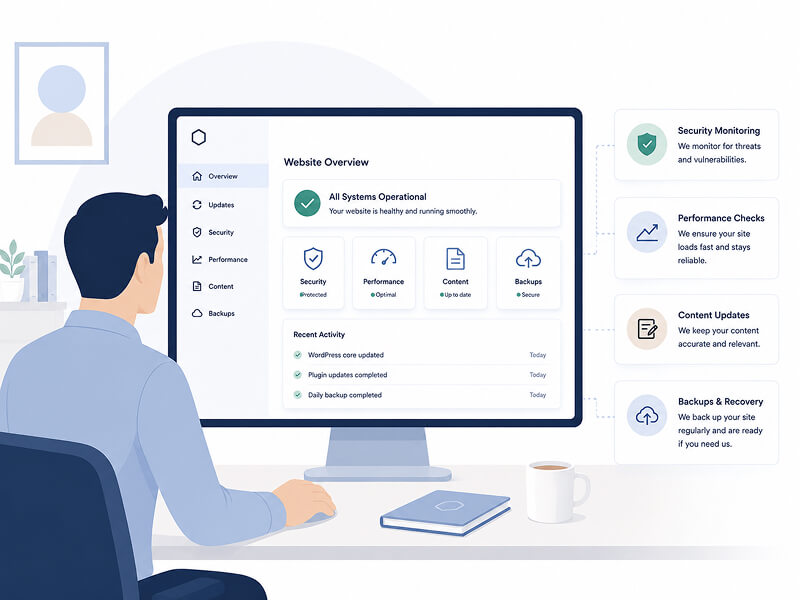
The Baseline: What Every Plan Should Cover
Regardless of the scope or scale of a maintenance arrangement, certain elements represent the minimum a business should expect from any ongoing web support relationship. These are not premium features but rather are the table stakes of responsible website stewardship.
Software and platform updates
Every website built on a content management system, a framework with ongoing releases, or third-party plugins and integrations requires regular updates. These updates exist for a reason, they patch security vulnerabilities, improve compatibility, and maintain the performance characteristics the site was built to deliver. A maintenance plan that doesn’t include regular, scheduled software updates isn’t maintaining the site. It’s simply leaving it alone and calling it something else.
Regular backups
A current, tested backup of the website is the foundation of any recovery plan if something goes wrong whether from a security incident, a failed update, or an accidental change. Backups should be automated, stored in a location separate from the site’s hosting environment, and verified periodically to confirm they can actually be restored. A backup that has never been tested is an assumption, not a safety net.
Uptime monitoring
A website that goes down without anyone noticing is a business development asset that has stopped working, often for longer than the business realizes. Basic uptime monitoring ensures that if the site becomes unavailable, someone is alerted immediately rather than the business finding out from a client or prospect who couldn’t reach them.
These three elements namely updates, backups, and uptime monitoring are the minimum. A maintenance plan that includes only these is better than nothing, but it is not a partnership. It is a safety net. The distinction matters.
Security Requires More Than Keeping Software Current
Software updates address known vulnerabilities, but they don’t cover the full surface area of website security. A maintenance plan that treats security as synonymous with keeping plugins updated is missing several important dimensions.
Active security monitoring such as watching for unusual activity, unauthorized login attempts, and signs of compromise, is a distinct and necessary layer of protection. A site can be running fully updated software and still be compromised through a weak password, a misconfigured server setting, or an attack vector that an update hasn’t yet addressed.
SSL certificate management is another element that is easy to overlook and consequential when it lapses. An expired SSL certificate triggers browser warnings that actively discourage visitors from proceeding to the site, and according to Google Search Central, sites flagged for security issues can face ranking penalties that compound the impact of what might otherwise be a minor and quickly fixed technical issue.
A genuine maintenance plan treats security as a continuous posture rather than a periodic task. It includes monitoring, not just patching, and it has a defined response plan for what happens if a security issue is detected, not just a hope that the monitoring catches things before they become serious.
Performance Monitoring Belongs in Every Serious Plan
A website’s performance at launch is not a permanent condition. As we cover in our article on why ongoing web partnership matters, performance drifts over time as content accumulates, scripts are added, and the benchmarks the site is measured against continue to evolve.
Google’s Core Web Vitals, which measure loading speed, visual stability, and interactivity are not static targets. They are assessed continuously, and a site that passed comfortably at launch can drift out of the recommended range as its content and code evolve. Because Core Web Vitals are direct search ranking factors, this drift has a compounding business impact: slower performance reduces conversion rates while simultaneously reducing the organic visibility that brings visitors to the site in the first place.
A maintenance plan that includes performance monitoring tracks these metrics on a regular basis, identifies what is driving any degradation, and addresses it before it becomes a meaningful problem. This is a proactive function, one that requires someone actively watching the numbers rather than waiting for a performance issue to become visible to visitors or to show up in declining traffic reports.
What a high-performing website looks like in terms of specific performance benchmarks, and what it takes to maintain that standard over time, is covered in depth in our article on what a high-performing business website actually looks like in 2026.
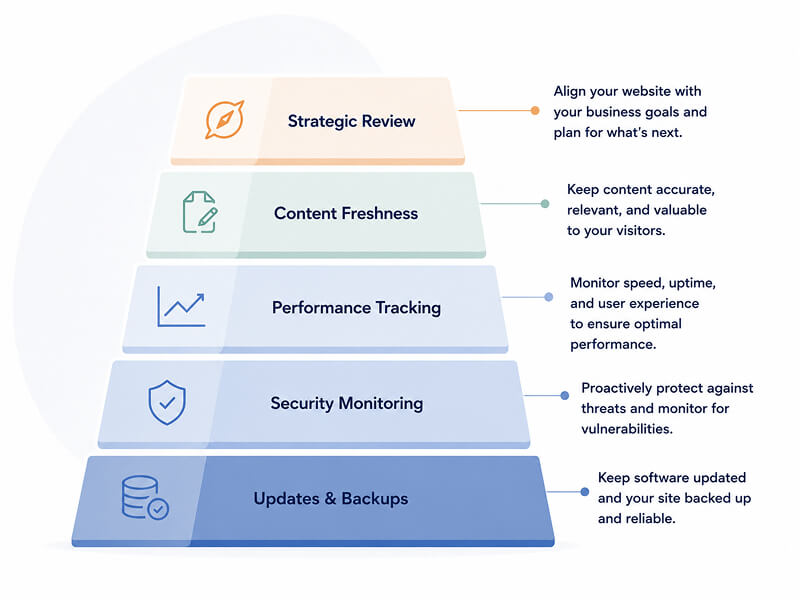
Content and Strategic Updates Are What Separate Maintenance From Partnership
Everything covered so far, specifically updates, backups, security, and performance monitoring, is essentially defensive. It preserves what was built. A genuine ongoing partnership goes further than preservation: it actively improves the site over time in ways that serve the business’s evolving needs.
Content updates are a basic expression of this. A website whose content doesn’t change signals to both visitors and search engines that the business isn’t actively engaged with its own digital presence. Services that have evolved, team members who have joined or departed, case studies from recent work, and blog content that demonstrates ongoing expertise, all of these require someone whose job it is to keep them current. A maintenance plan that doesn’t include any provision for content updates is a plan for a static site in a world that rewards active ones.
Strategic updates go further still. As the business grows, its website should grow with it such as new sections added, old ones retired, conversion paths refined based on how visitors are actually using the site, and positioning updated to reflect how the business’s understanding of its own value proposition has sharpened. This kind of ongoing refinement requires someone who knows the business well enough to make those judgments, which is precisely what a long-term partnership, as distinct from a transactional vendor relationship, is able to provide.
According to research from HubSpot, businesses that regularly update their website content generate significantly more leads than those that don’t. This is a finding that underscores the business case for treating content freshness as a maintenance priority rather than an occasional project.
Communication Shouldn’t Require a Monthly PDF
Some maintenance plans substitute a scheduled report for actual accessibility, a monthly summary that gets skimmed once and filed away, while the studio itself stays hard to reach in between. A genuine partnership works the other way: the business owner should always have a reasonably current picture of what's happening with their site, without waiting for a reporting cycle to catch up.
That doesn't require formal paperwork. It requires a studio that's straightforward about what's been done, what's being watched, and what's coming next, and that treats those questions as a normal part of the relationship rather than something reserved for a quarterly check-in. The value isn't in the document. It's in never having to wonder.
The real signal worth watching for isn't whether a studio sends reports, it's whether they're forthcoming when asked. A studio that's vague, slow to explain its work, or noticeably harder to reach once the contract is signed is telling you something about the relationship, regardless of how polished any paperwork looks.
What to Watch Out For
Given the range of what gets sold as a “maintenance plan,” there are several specific patterns worth being cautious about when evaluating an existing or prospective arrangement.
Plans that list tasks without defining outcomes.
A maintenance plan that specifies what will be done but says nothing about what will be achieved is a plan for activity rather than results. The point of maintaining a website is not to run updates but rather it’s to keep the site secure, performing, and aligned with the business. A plan worth having makes that connection explicit.
No defined response time for urgent issues.
A security incident, a site outage, or a critical error on a high-traffic page is an urgent business problem, and it demands a different standard than day-to-day communication. A maintenance plan that doesn’t define how quickly urgent issues will be addressed, and who specifically is responsible for addressing them, is a plan that may leave the business waiting at exactly the moment speed matters most.
Maintenance framed as a one-size-fits-all product.
Different websites have genuinely different maintenance requirements depending on their platform, their traffic, their functionality, and the pace at which the business itself is evolving. A plan that doesn’t account for these differences, that offers the same scope of service to every client regardless of their situation, is more likely optimized for simplicity on the studio’s side than for value on the business’s side.
No conversation about the site’s foundation.
Sometimes the right answer to a maintenance question is that the site’s foundation needs to be addressed before ongoing maintenance can be fully effective. A studio that is willing to have that conversation honestly, even when it means recommending a more significant investment, is demonstrating the kind of orientation toward the business’s actual interests that a long-term partnership requires. Our article on when it’s time to stop patching and start over covers how to recognize that threshold and approach it clearly.
The Standard Worth Holding
A website maintenance plan worth having is one that treats the site as a business asset rather than a piece of software to be kept from breaking. It covers the defensive fundamentals namely updates, backups, security, and uptime, with enough rigor that those concerns don’t require the business owner’s attention. And it goes further than defense: it actively keeps the site performing, growing, and aligned with the business over time.
That standard requires a genuine partnership, one built on continuity, honest communication, and a studio that is as invested in the site’s outcomes as the business itself is. As we explore in our guide on how to think about your website as a long-term investment, the value a website generates is not fixed at the moment it launches. It grows or erodes depending on the quality of the attention behind it, and a maintenance plan is, at its core, a commitment to that attention.
The businesses that hold that standard, that insist on a maintenance arrangement that actually serves their interests rather than simply existing, tend to find that their websites continue to perform, continue to generate leads, and continue to represent them accurately as the business evolves. That outcome is worth evaluating carefully for, and worth asking hard questions to get.
Is your current maintenance plan actually keeping your website secure, performing, and aligned with where your business is headed? Or is it simply keeping the lights on? Whether you’re evaluating your existing arrangement, looking for ongoing support for a new site, or simply trying to understand what a genuine web partnership should look like, let’s have that conversation.
Sources and Further Reading
Google Search Central — Manual Actions and Site Security
Google — Core Web Vitals Overview
Google Search Central — Understanding Page Experience
HubSpot — 2026 Marketing Statistics, Trends & Data