
Few questions produce a less satisfying search experience than “how much does a website cost.” The answers range from a few hundred dollars to six figures, often without explaining why, which leaves the person asking the question with more uncertainty than they started with.
The honest answer is that there isn’t a single number, not because the question is unanswerable, but because “a website” describes a category of vastly different things. A five-page brochure site and a custom platform with integrated booking, payment processing, and a content management system built around a specific business model are both “websites,” but they are not the same purchase, and they don’t belong on the same price scale.
Understanding what actually drives the cost of a website, rather than chasing a single number, is the more useful question, and it’s one with a much clearer answer.
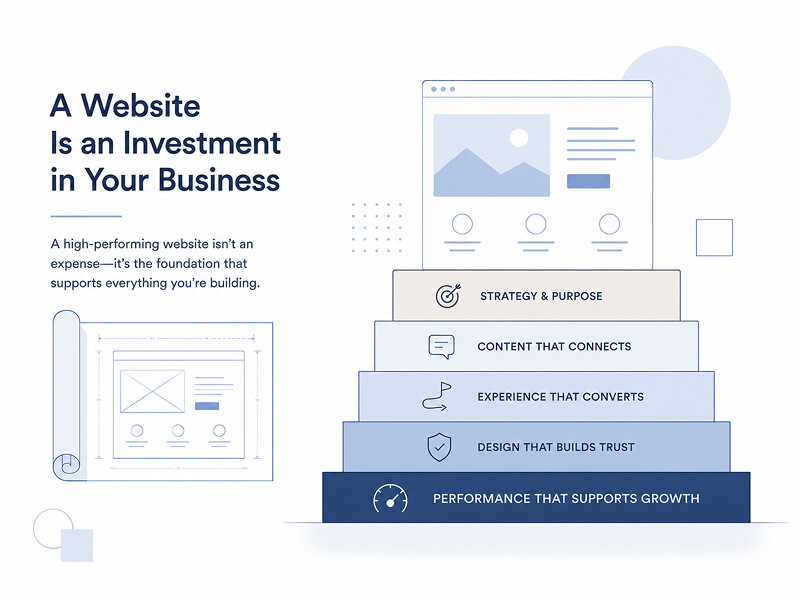
Why “It Depends” Is the Honest Answer
When a web development studio says the cost of a project “depends,” it can sound like a dodge. It isn’t. The price of a website is a direct function of a relatively small number of variables, and once those variables are understood, the wide range of quoted prices in the market starts to make complete sense.
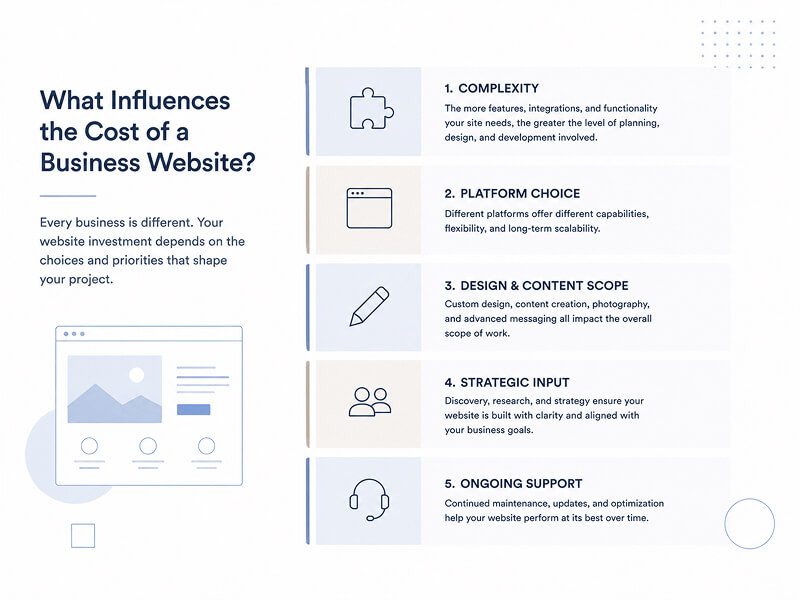
Those variables include the complexity of the site’s functionality, the amount of custom design and content involved, the platform it’s built on, the level of strategic and business input the project requires, and the ongoing support the relationship includes after launch. Two businesses with the same number of pages can have dramatically different costs if one needs a simple informational presence and the other needs custom integrations, a sophisticated content structure, or specific performance and security requirements.
This is why comparing website quotes by price alone, without understanding what’s actually included, rarely produces a useful comparison. The more productive question isn’t “what does a website cost” but “what does a website that does what I need it to do cost”, and that requires understanding the variables before the number.
Complexity Is the Single Biggest Driver
Of all the factors that influence website cost, functional complexity has the largest impact by a wide margin. A site that simply presents information such as who you are, what you offer, and how to contact you requires a fundamentally different scope of work than a site that needs to process payments, manage user accounts, integrate with business software, or support a large and frequently updated content library.
Every additional piece of functionality adds design work, development time, testing, and long-term maintenance considerations. A booking system has to handle edge cases. An e-commerce integration has to be secure and reliable. A custom dashboard has to be built, tested, and documented. None of this is padding since it’s the actual work required to build something that functions correctly and continues to function as the business and its needs evolve.
This is also why two businesses can describe their project in similar terms, “I just need a website for my business”, and receive dramatically different quotes once the actual functional requirements are understood. The phrase doesn’t capture the complexity; the requirements do.
Platform Choice Changes the Entire Cost Equation
The platform a website is built on whether it be a templated content management system, a more flexible CMS configured for specific needs, or a fully custom build has a significant effect on both upfront cost and long-term value.
A templated approach is generally faster and less expensive to launch, which makes it a reasonable fit for businesses with simple, well-defined needs that aren’t likely to change significantly. A custom build requires more upfront investment in design and development, but it offers flexibility, performance characteristics, and long-term scalability that a template often can’t match which matters for businesses whose needs will grow or whose requirements don’t fit neatly into a template’s constraints.
Neither approach is inherently better. The right choice depends entirely on the business’s specific situation, and choosing the wrong one for the wrong reasons such as picking a template because it’s cheaper when the business actually needs custom flexibility, or paying for custom development when a template would genuinely suffice is one of the more common and costly mistakes in this decision. We break down this decision in detail in our guide on choosing between WordPress and custom development.
Design and Content Are Often Underestimated
When business owners think about the cost of a website, the instinct is often to focus on development which is the technical work of building the site. But design and content frequently represent a comparable share of the total investment, and they are too often underestimated in early conversations about scope.
Thoughtful design isn’t simply choosing colors and fonts. It involves understanding the business’s positioning, mapping the visitor journey, structuring information for clarity and persuasion, and creating a visual system that holds together consistently across every page. Strong content, copy that’s written specifically for the business rather than adapted from a template requires research, strategy, and skilled writing, all of which take real time to do well.
A website that looks excellent and reads persuasively didn’t arrive at that quality by accident. That quality is the product of deliberate design and content work, and it is one of the most direct drivers of whether a website actually performs once it launches. Our article on why some businesses look smaller than they are online explores exactly what this investment produces, and what happens when it’s skipped.
Strategic Input Is the Difference Between a Website and a Business Asset
There is a meaningful difference between a vendor who builds what they’re told to build and a partner who helps determine what should actually be built. That difference shows up in price, but it also shows up dramatically in outcomes.
A studio that brings strategic input to a project asks questions a business owner may not have thought to ask: who is this site actually trying to convert, and what does that visitor need to see and feel to take action? What does the business’s competitive landscape look like, and how should the site position against it? What technical and structural decisions now will save cost and friction later, as the business grows?
That kind of input takes time and expertise, and it is reflected in the cost of working with a studio that provides it. But the alternative, a website built without that strategic layer, often costs more in the long run, in the form of underperformance, premature redesigns, or a foundation that doesn’t actually fit the business it was built for. Our guide on how to think about your website investment explores this calculation in more depth, specifically, how to weigh upfront cost against the value a website is actually capable of generating.
What Happens After Launch Matters as Much as the Build
One of the most overlooked cost variables is what happens after the website goes live. A site that launches and is then left untouched will degrade over time, security vulnerabilities accumulate, content goes stale, and the gap between the site and the business’s evolving needs widens until the original investment stops paying off.
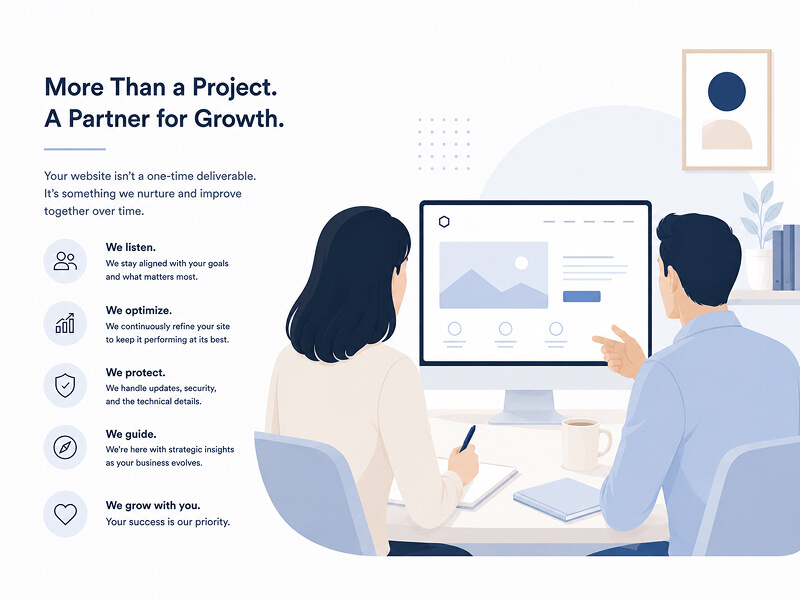
Ongoing support, updates, and refinement are a real and often necessary part of the total cost of a website, not an optional add-on, but a continuation of the value the initial build was meant to create. Studios that include this kind of ongoing partnership in their pricing are accounting for the website’s full lifecycle, not just its launch date.
This is also one of the clearest signals of the difference between a transactional vendor and a long-term partner. A business that understands this distinction tends to ask not just “what will this cost to build” but “what will this cost to keep performing”, and that’s the more financially sound question to be asking.
How to Actually Evaluate a Quote
Given everything above, the most useful way to evaluate a website quote isn’t to compare it against a number you found online. It’s to ask what’s actually included and to make sure you’re comparing the same scope of work across any options you’re considering.
A meaningful evaluation asks: does this quote account for the actual functional complexity my business needs, not just what I initially described? Is the platform the right fit for where my business is headed, not just where it is today? Does the price reflect real design and content work, or a template with my logo swapped in? Is there strategic thinking behind the recommendations, or is this purely an order taken and fulfilled? And what does the relationship look like after launch, is there a plan for the site to continue performing, or does the engagement end the moment it goes live?
A quote that accounts for all of these factors may look higher on paper than one that doesn’t. But it is very often the more economical choice once the full lifecycle of the website, not just its launch, is taken into account. If your current site has already reached the point of diminishing returns, our article on when it’s time to stop patching your website and start over can help clarify whether a rebuild is the right next step before you start evaluating quotes at all.
The Real Question Worth Asking
The cost of a website isn’t a mystery, and it isn’t arbitrary. It’s the sum of a defined set of variables, particularly complexity, platform, design, content, strategy, and ongoing support, applied to your business’s specific situation. The wide range of prices in the market reflects the wide range of what “a website” can actually mean, not an industry without logic to its pricing.
The more productive starting point than “what does a website cost” is “what does my business actually need, and what is that worth to me.” Answered honestly, that question leads to a far clearer and more useful number than any general estimate ever could.
Not sure what your project would actually require or what that should reasonably cost? Whether you’re comparing quotes, trying to scope a new site, or simply trying to understand what’s realistic for your business, an honest conversation is the fastest way to get a real answer instead of a guess. Let’s talk through what your website actually needs.
Sources and Further Reading
Google Search Central — Understanding Page Experience
HubSpot — 2026 Marketing Statistics, Trends & Data