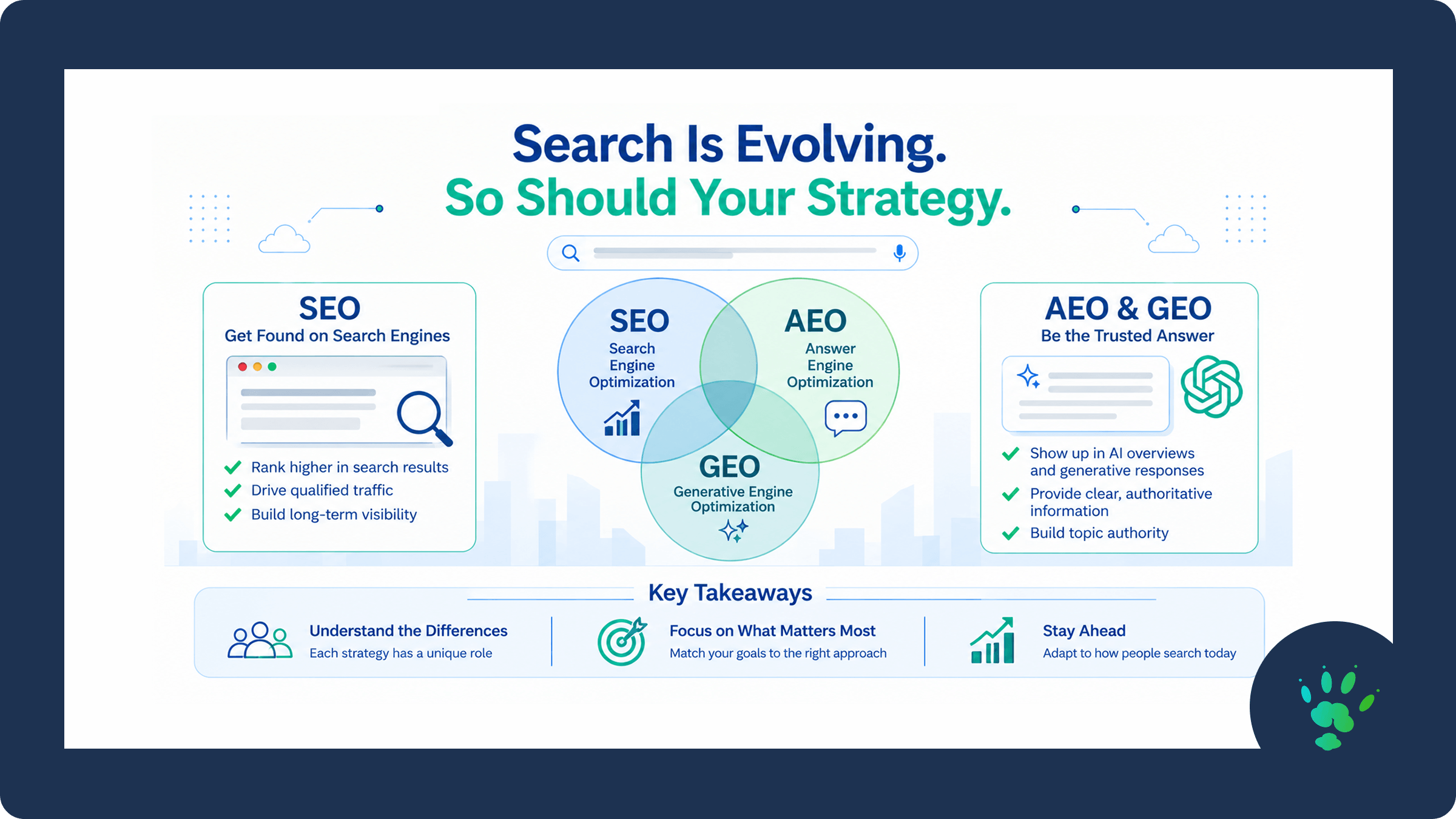
A clear-eyed guide for business owners who want to be found by search engines and AI assistants alike.
AEO, short for answer engine optimization, and GEO, short for generative engine optimization, are two names for the same broad goal: making a business visible inside the answers that AI tools produce. Those tools include Google's AI Overviews and AI Mode as well as assistants such as ChatGPT, Gemini, and Perplexity. The terms overlap, the foundation underneath them is still SEO, and the differences that matter are about emphasis: being clear, being cited, and being described consistently wherever a business appears.
That makes this a practical question for any business owner and not a technical curiosity. HubSpot describes buyers turning to tools like ChatGPT, Perplexity, and Gemini while they research, which means the question of who to trust is increasingly answered before anyone visits a website. This article explains what the terms mean, what the main sources agree on, where they differ, and where to put effort first.
What Are AEO and GEO?
Both terms describe the practice of improving how often and how accurately a business appears in AI-generated answers. That is close to HubSpot's definition of answer engine optimization, which frames the goal as being included in the answers buyers receive while they research, so that the business is already familiar by the time they are ready to buy.
The two labels are used inconsistently. HubSpot describes generative engine optimization as a strategy for broader visibility across multiple AI-generated sources, and notes that some experts treat GEO as the umbrella term with AEO as a subset, while HubSpot does the reverse. For a business owner, the debate matters less than the goal. Whichever label is used, the work is about becoming a source that AI tools can find, understand, and trust.
How Is AEO Different From SEO?
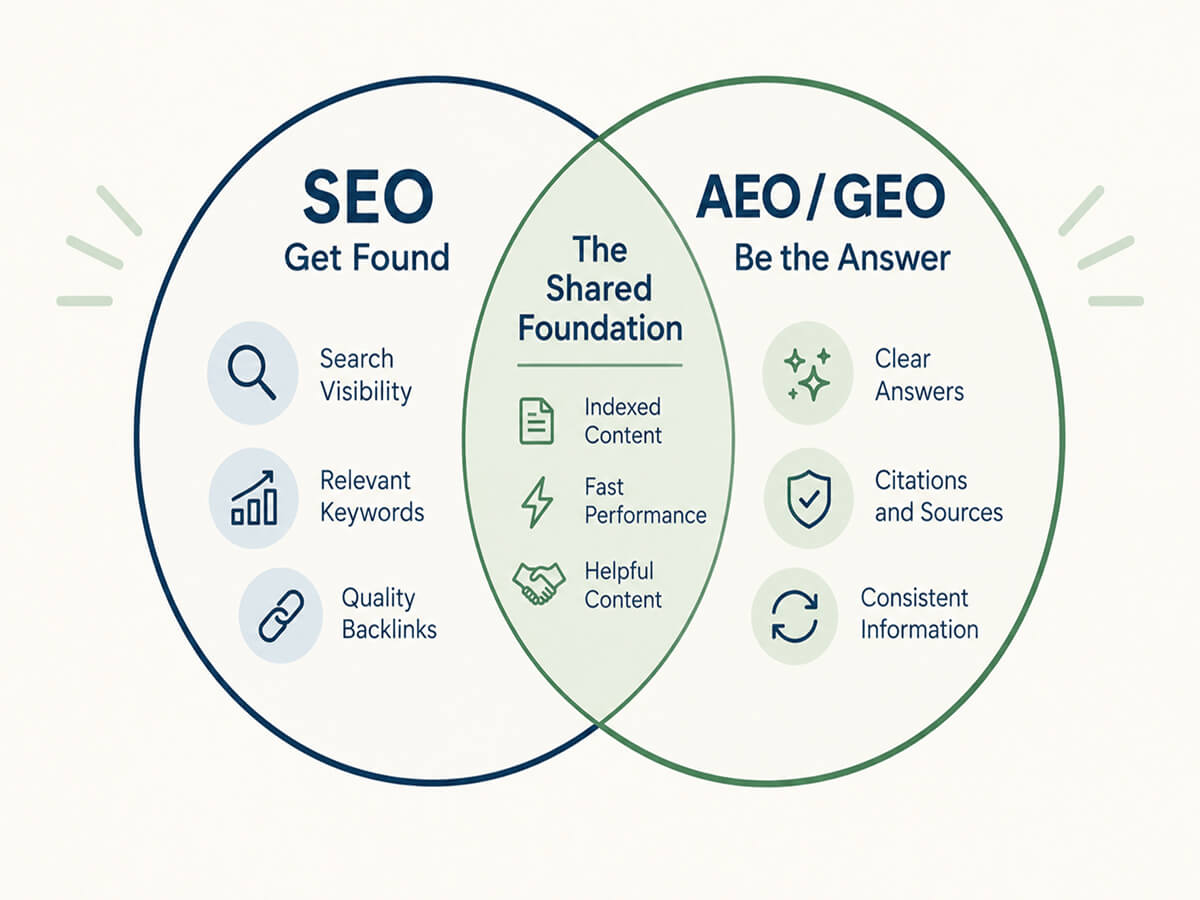
SEO aims to rank pages in search results and earn clicks. AEO aims to make a business the source an AI tool draws on when it assembles an answer, often in a setting where the reader may never click through. HubSpot summarizes the shift as moving from getting people to click toward becoming the authoritative source that answer engines trust and reference.
The two are not rivals. HubSpot is explicit that AEO does not replace SEO, and it notes that many answer engines draw from pages that already rank well organically, which makes SEO a prerequisite. A business with a thin, slow, or poorly indexed website has little to offer either kind of engine. Strong SEO foundations come first, and AEO adds closer attention to how clearly and consistently the business is described.
Does Google Treat AI Search as a Separate Discipline?
No. Google's own guide to optimizing for generative AI features states that, from its perspective, “optimizing for generative AI search is optimizing for the search experience, and thus still SEO.” It explains that these features are rooted in Google's core ranking and quality systems, and that a page must be indexed and eligible to appear in Search with a snippet to be used in them.
The guide is equally direct about what is unnecessary. Structured data is not required for Google's generative AI features, and no special markup exists for them. New machine-readable files created for AI are not needed. Content does not have to be broken into small pieces, or written differently, to be understood. Google also advises reviewing third-party AEO and GEO advice carefully before acting on it.
This sits slightly apart from advice elsewhere. HubSpot, for example, recommends adding schema and building content around question-style headings. The two are easy to reconcile once the scope is clear. Google is describing its own products, and other assistants publish far less about how they choose sources. Clear structure and schema carry little downside and can help readers and other systems, but no single technical trick should be expected to guarantee a place in AI answers.
How Do AI Tools Decide What to Cite?
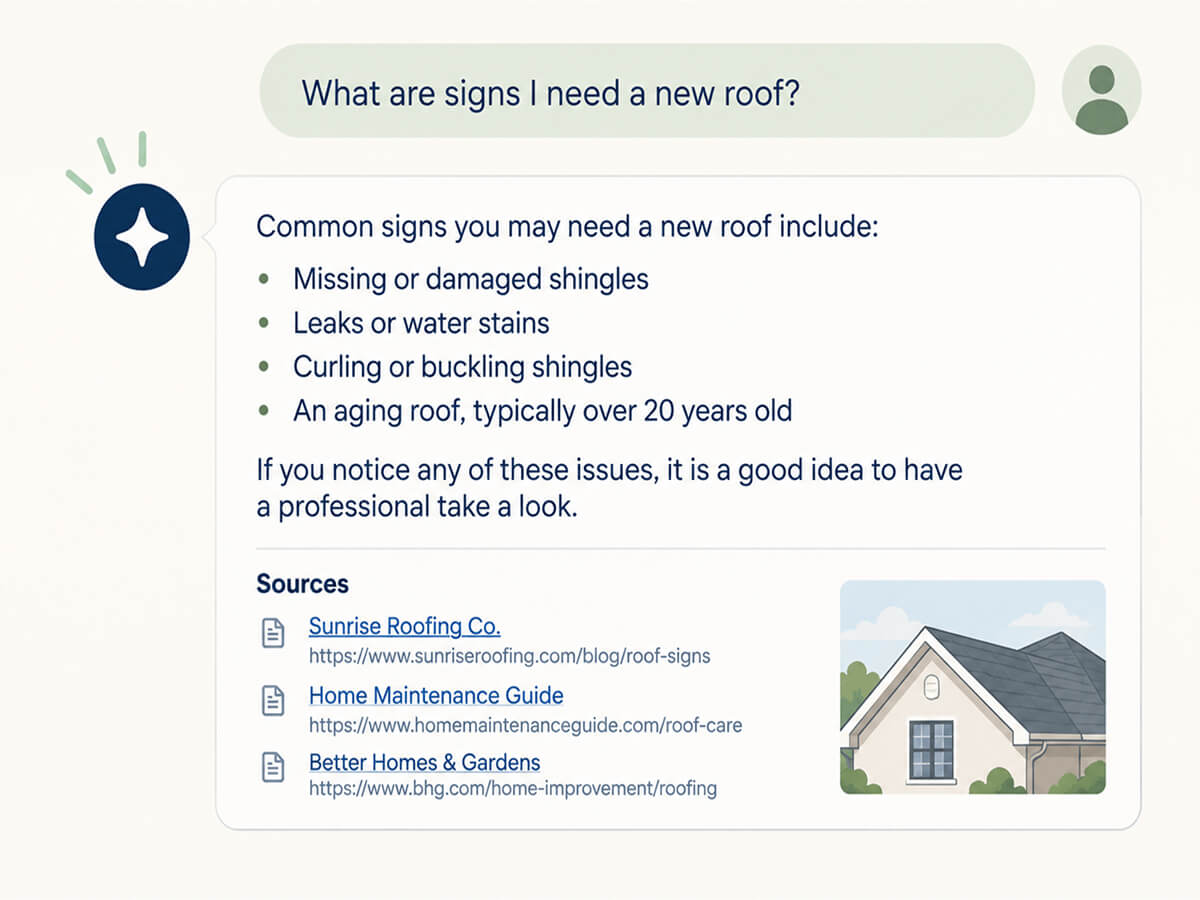
The mechanics differ between products, and most are not fully published. Google's guide offers a useful picture for its own features. They rely on grounding, which retrieves pages from the Search index to support a generated answer, and they break a question into several related searches, a technique it describes as query fan-out, to gather material. In plain terms, the AI does not answer from memory alone. It looks things up, and it looks up more than the single question that was asked.
That has a practical consequence. A business is not competing only for the exact question a buyer types. It is competing for the related questions that sit around it: what something costs, how long it takes, who it suits, and what can go wrong. A website that covers those surrounding questions well gives the system more reasons to retrieve it.
What Actually Helps a Business Appear in AI Answers?
The most reliable answer is original, useful content that reflects what the business genuinely knows. Google's guide advises creating content yourself, based on your own knowledge of the topic, and places commodity content and pages produced in bulk to influence AI responses outside what it recommends. For a studio, a clinic, or a consultancy, that means specific answers drawn from real experience and not generic summaries that any competitor could publish.
Clarity comes next. HubSpot recommends building content around the questions buyers actually ask, using the question as a heading and giving a concise answer straight away, with supporting detail after. That structure suits human readers as well, which is reason enough to follow it, whatever any particular AI tool does with it.
Consistency matters because AI tools assemble impressions from many places. HubSpot points to the importance of keeping the about page, author bios, and basic brand details consistent. A business that describes itself in three different ways across its website, directories, and profiles makes it harder for any system, or any person, to be sure what it does.
Finally, genuine presence beyond the website helps: reviews from real clients, mentions from partners and publications, and listings in the places a business's category belongs. HubSpot lists off-site presence as part of building authority, while Google cautions that seeking inauthentic mentions is less helpful than it might seem. The sensible reading is to earn mentions through good work and not to manufacture them.
Which Kinds of Content Tend to Be Cited?
HubSpot's State of AEO research reports that platforms differ in the kinds of content they cite most often, with comparison content, documentation and resource pages, and blog posts all appearing prominently depending on the assistant. The details shift quickly and are worth checking against current data, but the pattern is clear enough to act on. Pages that explain, compare, and document are more useful to an answer engine than pages that only announce.
For a service business, that points toward honest comparisons of the options a client faces, plain explanations of how the work is done and what it takes to do it well, and clear documentation of process. These are also the pages that careful buyers actually read, which makes them worth building regardless of any AI tool. A page that explains who a service suits, and who it does not, is more quotable and more trustworthy than one that claims to suit everyone.
What Should a Business Be Skeptical Of?
Any promise of guaranteed placement in AI answers deserves doubt. Google notes that no third-party tool has access to its internal ranking or AI systems, so claims to the contrary should be treated skeptically. The same caution applies to secret formulas, bulk content designed to game AI responses, and purchased mentions. These tend to be expensive and fragile, and they do not match how Google describes its own systems.
A fair test of any advice is whether it would still make sense if AI search changed again next year. Original answers, a fast and well-structured website, consistent business details, and genuine client reviews all pass, because they serve readers as much as machines. Tactics that only make sense as tricks aimed at one particular tool tend to fail that test, and they tend to age badly as the tools change.
Timelines deserve realism too. HubSpot suggests planning on three to six months for meaningful results from AEO work, which is consistent with how SEO has always behaved. A business that is promised overnight visibility is probably being sold something.
How Do You Measure Visibility in AI Answers?
Measurement is still maturing, and the honest answer is that it is partly direct and partly indirect. For Google, Search Console includes a generative AI performance report, which Google points to as the way to see how a site performs in these features. For other assistants there is no equivalent official source, so measurement leans on observation.
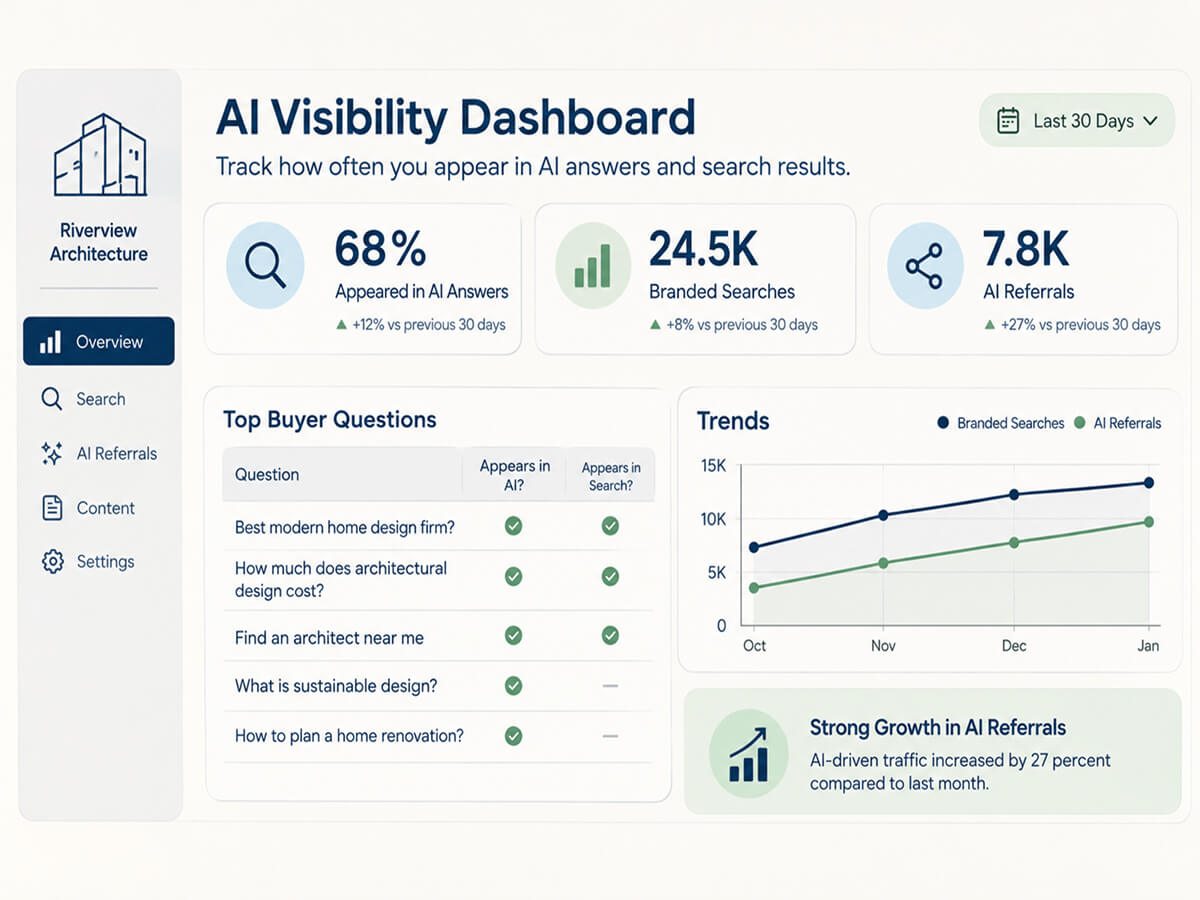
HubSpot suggests tracking how often a brand is cited in AI answers, its share of voice against competitors, branded search volume, direct traffic, and referral traffic from AI tools. A simple starting habit is to keep a short list of the questions your ideal clients ask, put them to several assistants once a month, and note whether the business appears and how it is described. Results vary between sessions, so treat them as directional and not exact.
Why Does Your Website Matter More, Not Less?
Every one of these approaches begins with the website, because it is the source material. AI tools can only cite what they can find, read, and trust. Crawlability, speed, and clean structure decide whether a site is even eligible, and the qualities described in what a high-performing business website actually looks like in 2026 decide whether it is worth citing.
Upkeep matters as well. Content that is accurate this year and stale next year slowly stops being useful to readers and to the systems that serve them. A proper maintenance arrangement, of the kind described in what a website maintenance plan should actually include, keeps performance, security, and content current so the site continues to deserve its place in the answers.
Where Should a Business Start?
Start with the questions. List what prospective clients ask before they hire, then check whether the website answers each one specifically and honestly on a page of its own. Make sure those pages are indexed and load quickly. Align the way the business is described across the website, profiles, and directories. Put real expertise on the page, with named authors where it suits. Then check Search Console, run a monthly set of test questions, and be patient.
Treat it as an ongoing practice and not a one-time project. Assign someone to review the key pages every few months, correct anything that has gone out of date, and add new answers as clients ask new questions. The compounding effect that makes SEO valuable applies here too, and it rewards the business that keeps showing up consistently.
Some businesses handle this in house, and others fold it into broader SEO and content strategy work with a web partner, which is where a content audit, ongoing publishing, and technical upkeep tend to sit together. Either route works as long as someone owns it.
None of this is exotic, and that is the point. The businesses best placed for AI search are largely the ones that were already doing good SEO and good communication, and are now paying closer attention to clarity, consistency, and proof.
If someone asked an AI assistant to recommend a company like yours, would your business be part of the answer? If you're not sure, that is worth finding out. Whether your SEO is solid but you've never checked how AI tools describe you, your content feels thin next to what clients actually ask, or you're simply ready to build a presence that earns its place in both search and AI answers, let's have a conversation that starts with how your business shows up today, in search and in AI answers. From there, becoming the answer people are looking for is a very reachable standard.
About the Author
Honeyfoot Co is a founder-led boutique web development studio based in South Florida, where clients work directly with studio leadership for a more personal, hands-on experience. The studio designs, builds, and maintains websites for business owners across the United States, and offers SEO and content strategy (including optimization for AI answers and AI search), e-commerce, website maintenance, and strategic consultation.
Sources and Further Reading
Google Search Central: Google's Guide to Optimizing for Generative AI Features on Google Search
HubSpot: What Is Answer Engine Optimization (AEO), and How Does It Change SEO?