The Friction, Trust Gaps, and Habits Keeping Bookings on Someone Else's Platform
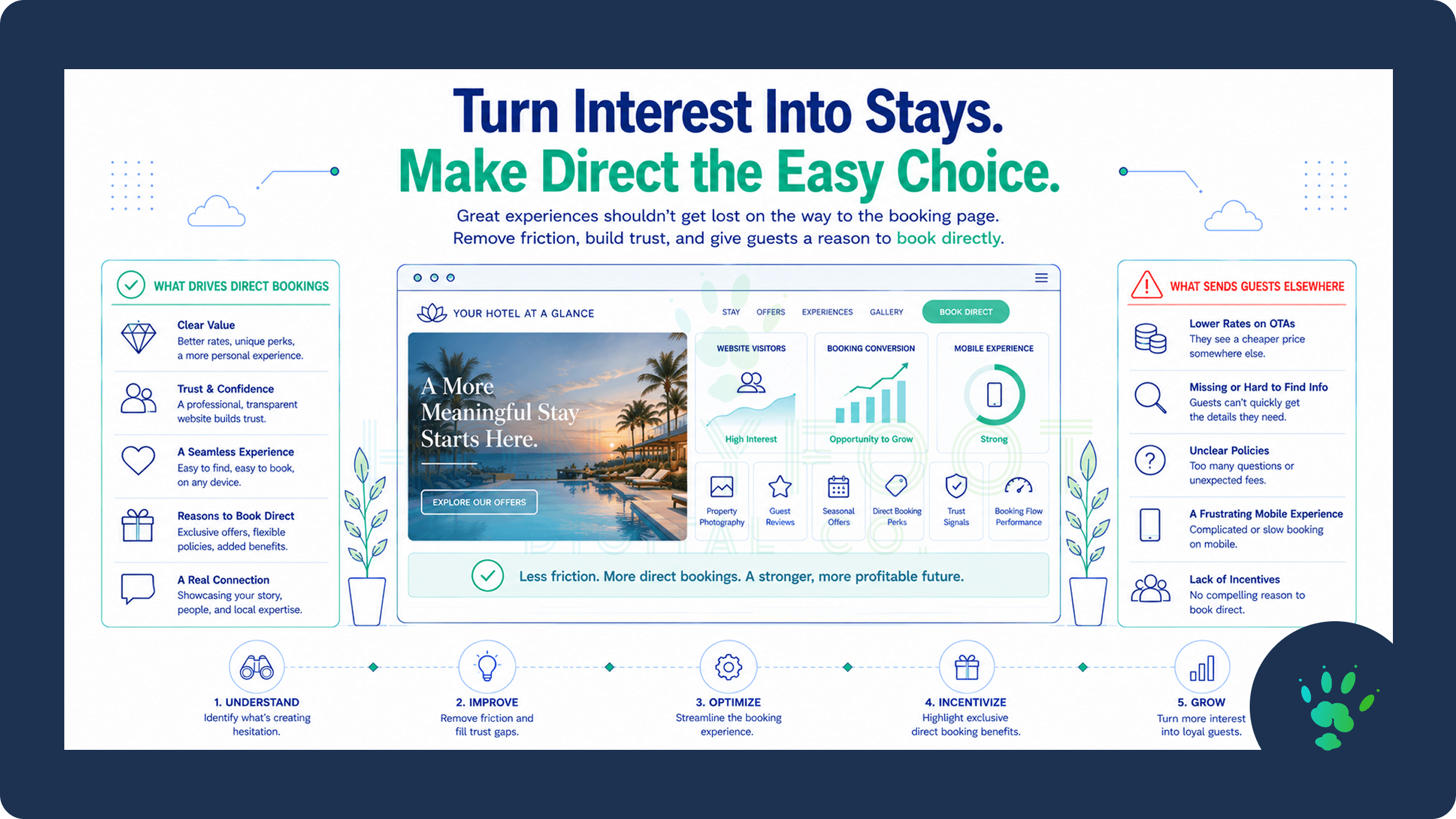
Most hospitality and luxury service business owners already know direct bookings are better than third-party ones. The commission math isn't a secret, and few decision-makers need convincing that keeping more of each reservation in-house beats giving a meaningful cut of it away. Knowing that, though, hasn't been enough to actually shift the behavior, and the reason usually isn't awareness. It's that the website itself isn't giving guests a real reason to choose it over the easier, more familiar alternative.
This is worth diagnosing honestly rather than assumed away. The gap between believing direct bookings are better and actually capturing them is where most of the opportunity is currently being lost, and it's a gap a website can close, once the specific friction points are actually identified.
The Cost That's Easy to Miss
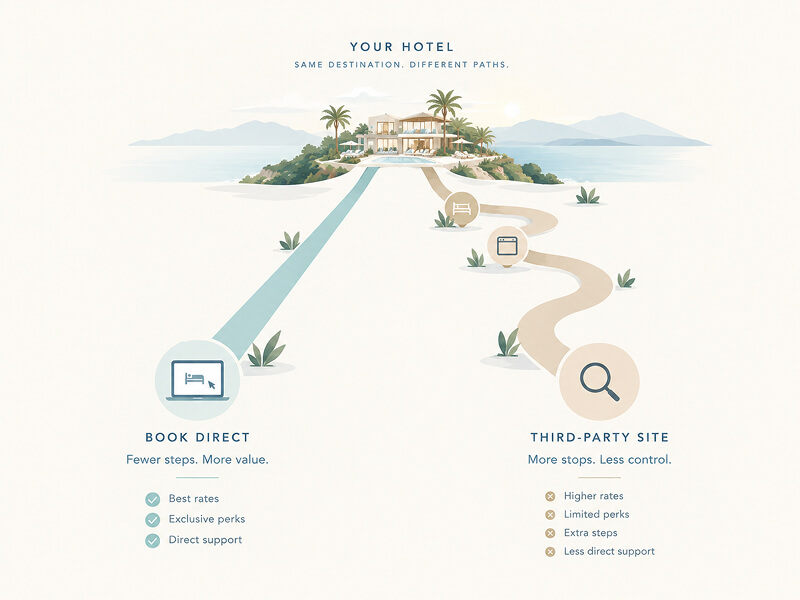
A commission taken on every third-party booking is not a marketing expense a business chooses to spend. It's a cut taken automatically, on every transaction, regardless of how that guest actually found the business. Over the course of a year, across dozens or hundreds of reservations, that adds up to a meaningful share of revenue that never had to leave the business in the first place, if the guest had simply booked directly instead.
The reason this cost is so easy to overlook is precisely because it never appears as a bill. It's baked into the transaction itself, deducted before the business ever sees the money, which makes it feel less like an expense and more like simply the cost of doing business. Treating it that way, rather than as a genuine and often substantial line item, is exactly how it stays invisible year after year.
Why Businesses End Up Depending on These Platforms Anyway
None of this happens because business owners are making a poor decision. Third-party platforms offer real, tangible value: built-in visibility, aggregated demand, and a level of trust that comes from an established, familiar brand doing the introduction on the business's behalf. For a new or lesser-known property or service, that visibility can be genuinely difficult to replicate independently, especially early on.
The dependency tends to deepen over time simply because it's convenient. Once a meaningful share of bookings is flowing in through a familiar channel, there's little immediate pressure to build the direct alternative, even as the cumulative cost of that convenience continues to grow quietly in the background.
What a Website Has to Do to Actually Compete
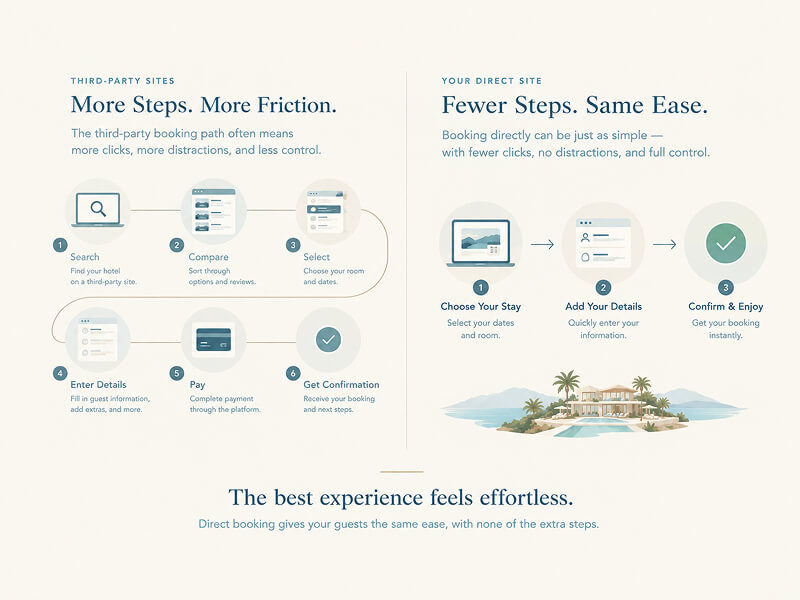
A generic, static website was never going to out-convert an aggregator built specifically to make booking as frictionless as possible. Competing with that convenience requires taking the booking experience as seriously as the third-party platform does: real-time availability where feasible, a clear and simple path to confirmation, and none of the friction that pushes a visitor back toward the easier, more familiar alternative.
This is also where mobile performance becomes non-negotiable rather than optional. A meaningful share of travelers comparing options do so from a phone, often side by side with an aggregator's app, and a direct booking path that's slower or more cumbersome than the third-party alternative is simply asking to lose that comparison.
Google Is Actively Rewarding the Direct Path
This isn't just a theoretical argument. Google itself has built infrastructure specifically to help businesses capture direct bookings instead of losing that traffic to a third-party intermediary. Through its Hotel Center program, Google's own documentation describes free booking links that let a business's own website appear directly alongside paid listings in hotel search results, at no cost and with no commission owed on the resulting booking.
This matters beyond the hospitality-specific mechanics of the program itself. It reflects a broader shift: search behavior increasingly rewards businesses that make themselves bookable directly, rather than only discoverable through an intermediary. A business with a strong, direct-booking-capable website is positioned to take advantage of this shift. A business still routing everything through third parties is leaving that opportunity on the table, sometimes without realizing the opportunity exists at all.
Building the Trust a Third-Party Platform Lends for Free
Part of what makes third-party platforms convenient is that they arrive pre-loaded with trust: aggregated reviews, a recognizable brand, and the implicit reassurance of a familiar name handling the transaction. A direct booking path has to earn that same confidence on its own, without borrowing it from an established intermediary.
This is precisely why atmosphere, specificity, and visual proof matter so much for this category of business. A generic, thin website asking a visitor to book directly, without doing the work of building genuine trust first, is asking that visitor to take on more risk than booking through a familiar platform would require. Closing that trust gap is a precondition for direct bookings actually happening at scale, not an optional nice-to-have layered on afterward.
Actually Running the Numbers
Most businesses have a rough intuition that third-party bookings cost something, but few have actually sat down and calculated what that cost looks like across a full year. This is worth doing directly rather than estimating: total revenue from third-party bookings, multiplied by the commission rate charged on that channel, produces a real number that's often larger than expected once it's isolated from the rest of the business's finances.
It's also worth comparing that figure against what it would reasonably cost to strengthen the direct booking channel, whether that's a more capable booking system, stronger photography, or improved trust signals throughout the site. In many cases, the investment required to meaningfully shift the balance toward direct bookings pays for itself well within the first year, simply by reducing how much revenue is being diverted to commissions on an ongoing basis. Framing this as a return-on-investment calculation, rather than an abstract improvement, tends to make the case far more concrete for a business owner deciding where to focus limited resources.
Data and the Guest Relationship Are Part of This Too
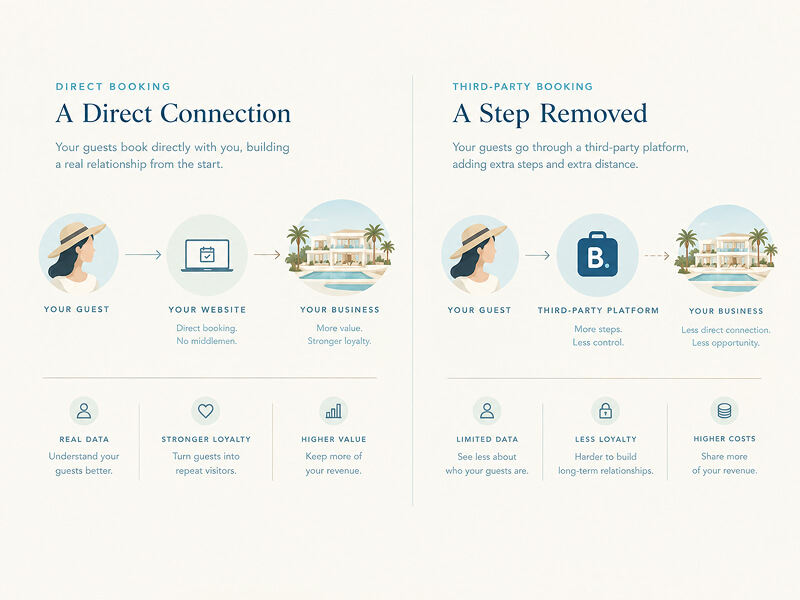
Commission cost is the most immediately quantifiable reason to care about direct bookings, but it isn't the only one. A booking made through a third-party platform typically means the business never actually captures the guest's contact information, purchase history, or preferences. That information stays with the intermediary, not the business that actually delivered the experience.
This has real consequences beyond a single transaction. A guest who books directly can be remembered, followed up with, and invited back. A guest who books through a third party is, from the business's perspective, often a stranger who happens to show up on a given date, with no direct relationship the business can build on afterward. Over time, this compounds: repeat guests, referrals, and genuine brand loyalty are all harder to cultivate when the business never actually owns the relationship in the first place.
Pricing Consistency Matters More Than It Seems
A subtle but real cost of heavy third-party dependence is losing control over how the business's pricing is actually presented. Aggregators sometimes display rates alongside competitors, occasionally with promotional framing or bundled pricing that the business itself didn't choose and may not have full visibility into. A guest comparing options on an aggregator is evaluating the business partly through a lens the business doesn't control.
A strong direct channel puts that control back where it belongs. The business decides how its own rates, packages, and value are actually presented, without a third party's interface, algorithm, or competing listings shaping that first impression. This is a quieter benefit than the commission savings, but it matters for a category of business where positioning and perceived value are central to the entire purchase decision.
Making the Direct Path Worth Choosing
Convenience alone often isn't enough to shift booking behavior away from a familiar third-party habit. Giving visitors an actual reason to choose the direct path, rather than simply hoping they will, makes a measurable difference. A clearly communicated price-match or best-rate guarantee, a small direct-booking perk, or simply transparent, trustworthy pricing without the ambiguity some travelers associate with certain aggregator listings, all give a visitor a concrete reason to book on the business's own site instead of defaulting to the familiar alternative out of habit.
This doesn't need to be an aggressive discounting strategy. Even a modest, clearly stated incentive changes the calculation for a visitor who was otherwise going to book through whichever channel required the least thought, simply because no one gave them a reason to consider the alternative.
This Isn't About Abandoning Third-Party Platforms
None of this is an argument for exiting third-party platforms entirely. For many businesses, that discovery channel remains a genuinely valuable source of new guests who might never have found the business otherwise. The goal isn't elimination. It's balance: treating third-party platforms as one channel among several, rather than the default path for every booking, and making sure the business's own website is actually capable of capturing its fair share of direct demand instead of quietly ceding all of it to commission.
A business that's overly dependent on a small number of third-party channels is also more exposed to changes in those platforms' policies, fees, or algorithms, factors entirely outside the business's own control. A strong direct booking channel isn't just about margin. It's about not being fully at the mercy of decisions made by companies with their own, sometimes misaligned, incentives.
What This Looks Like in Practice
None of this requires abandoning existing distribution relationships overnight. It requires treating the website's own booking capability as seriously as it deserves, closing the trust and convenience gap that currently sends guests elsewhere, and giving visitors an actual reason to choose the direct path when they have one available. The businesses that do this well aren't necessarily generating more total bookings. They're simply keeping a meaningfully larger share of the revenue those bookings were always going to generate.
Do you know exactly what's stopping guests from booking directly with you, or are you just hoping more of them eventually will? If your website hasn't been evaluated specifically for booking friction, trust gaps, and mobile performance against the third-party alternative, that gap is worth identifying before assuming it will close on its own. Let's find out what's actually sending your bookings elsewhere.
Sources and Further Reading
Google (Hotel Center): About Hotel Free Booking Links