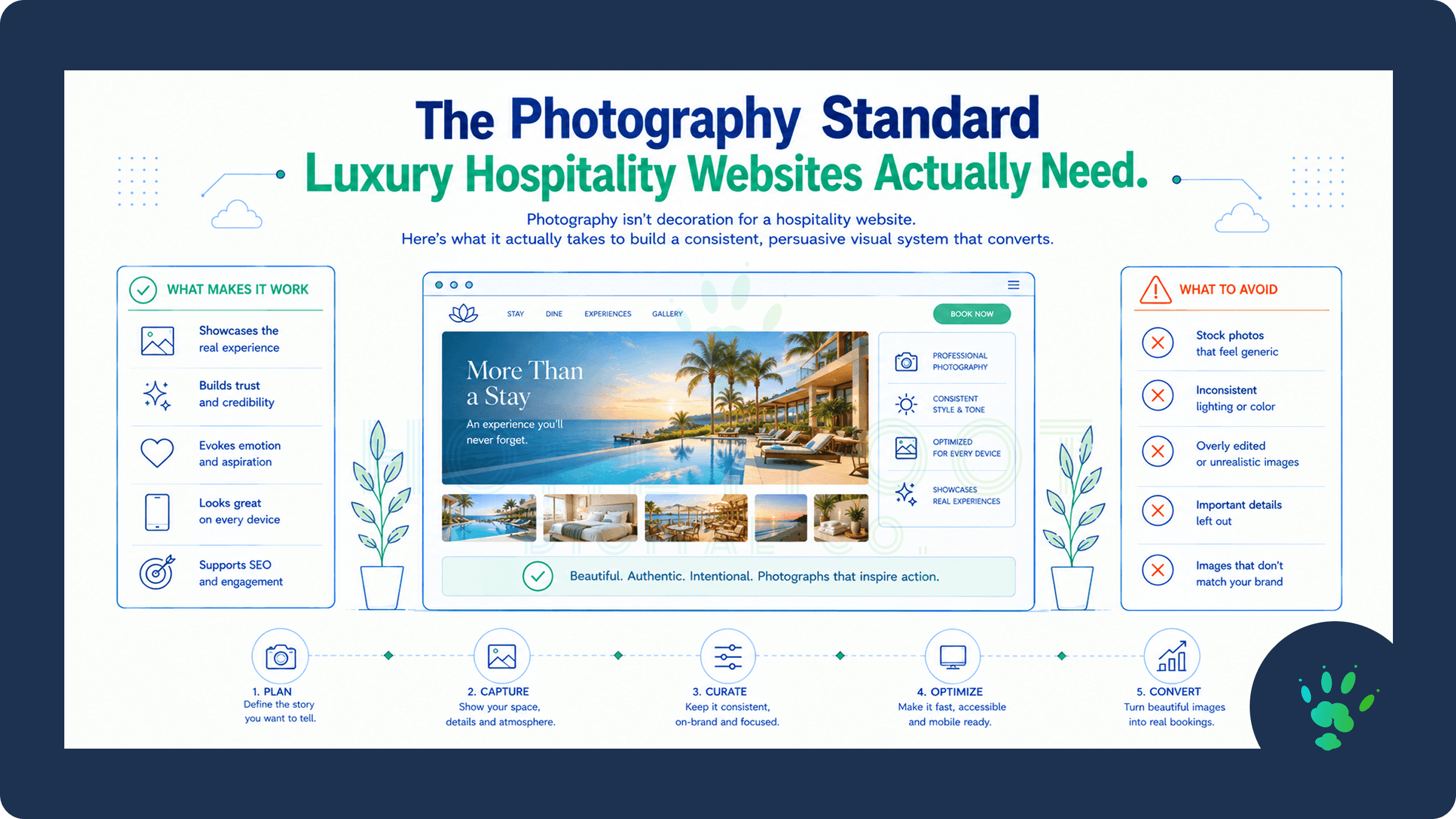
Good Enough Photography Is Its Own Kind of Cost
Most business advice on website photography stops at a single instruction: hire a professional photographer. That's necessary, but it isn't sufficient for hospitality and luxury service businesses, because the actual standard has to go further than simply avoiding amateur images. Photography on these sites isn't illustrating the offering. It largely is the offering, at least until a guest actually arrives.
This changes what “good photography” needs to mean. It isn't a single striking hero image. It's a coherent, consistent visual system that carries a visitor from first impression through to the moment they're ready to book. Treating photography as a checklist item, something to secure once and move past, misses just how much ongoing weight these images are actually carrying throughout the entire visitor journey.
Why “Good Enough” Actually Costs More Than It Saves
A common pattern among hospitality and luxury service businesses is treating photography as a one-time expense to minimize rather than an ongoing asset to invest in. A handful of decent photos taken at launch, reused for years, technically fills the space where images are supposed to go. It just doesn't do the job those images are actually there to do.
The cost of underinvesting here rarely shows up as an obvious problem. It shows up as a quieter, harder-to-diagnose one: visitors who leave without booking, without ever articulating that the photography played a role in that decision. A business evaluating its marketing spend by looking only at what it paid, rather than what mediocre photography may be quietly costing in lost bookings, is optimizing for the wrong number. The true cost of weak photography is almost never visible on an invoice. It shows up later, distributed across every visitor who quietly chose somewhere else.
Consistency Matters More Than Any Single Great Shot
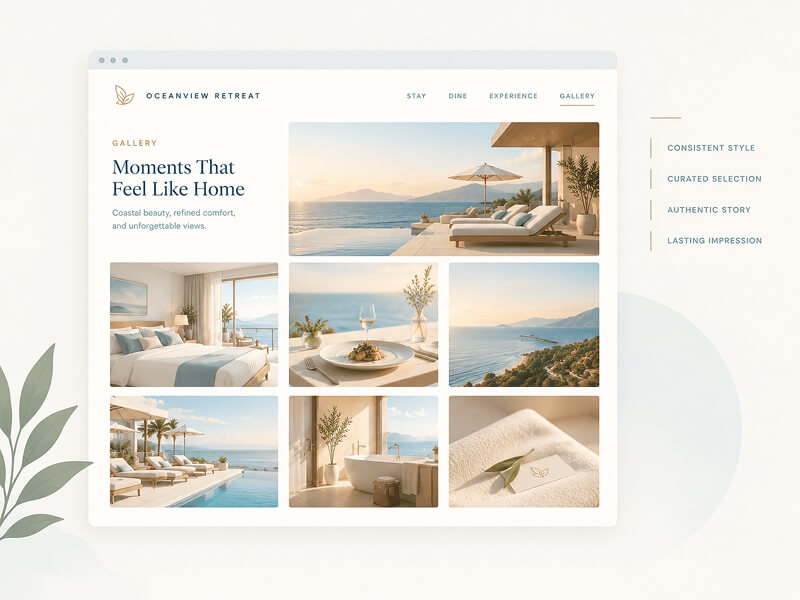
A single beautiful photo doesn't compensate for an otherwise inconsistent gallery. Visitors evaluating a hospitality or luxury purchase tend to notice unevenness, a stunning hero image followed by a handful of flat, differently lit, or oddly cropped supporting shots, and that inconsistency undermines the very confidence the strong image was trying to build.
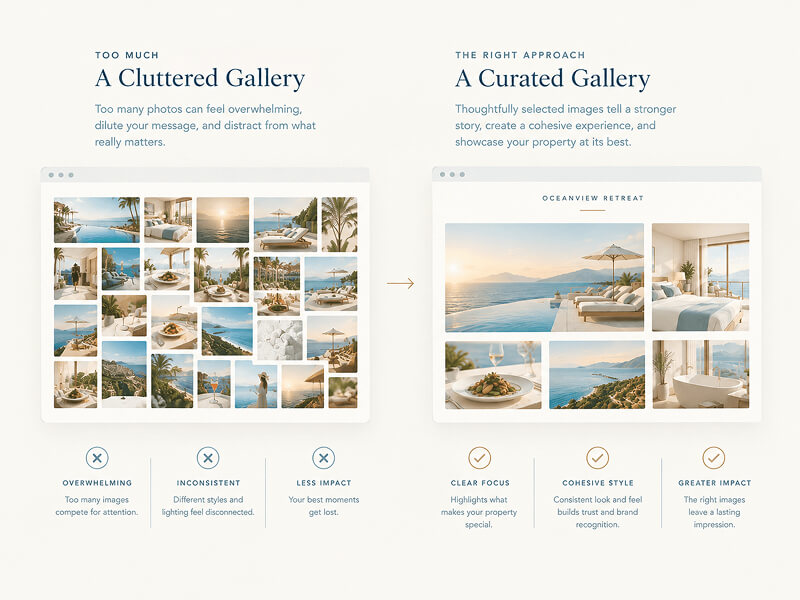
This means the standard to aim for isn't “our best photo is excellent.” It's “every photo on this site meets the same bar.” A gallery with fifteen average images but consistent lighting, framing, and tone often performs better than one with three exceptional images surrounded by inconsistent filler, because the consistent version reads as intentional and the uneven one reads as assembled.
What to Actually Photograph, and What to Skip
Not every corner of a property or every detail of a service needs its own photo. The goal is to photograph what actually communicates the experience, not to exhaustively document everything that exists.
Spaces should generally be shown as a guest would actually encounter them: the arrival sequence, the spaces where time is actually spent, the details that reflect genuine care rather than generic amenities. Wide shots establish context, but closer, more intimate shots, the texture of linens, the detail of a table setting, the specific character of a room, often do more to convey quality than another wide establishing shot ever could.
It's just as important to know what to leave out. Photographing every room from every angle produces a gallery that's exhausting to browse and dilutes the impact of the images that actually matter. A tightly curated set of strong images consistently outperforms an exhaustive one.
Story Sequencing: Images Should Have an Order
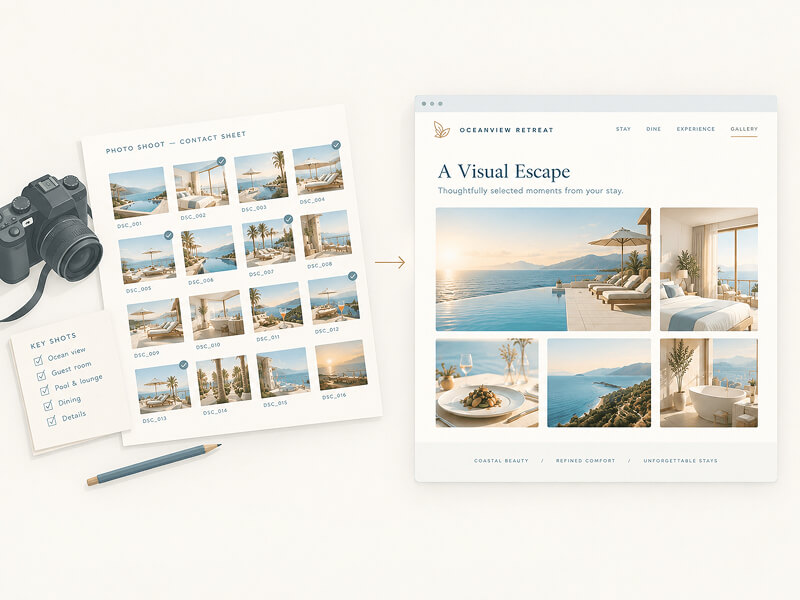
A photo gallery dumped onto a page without intentional sequencing asks the visitor to do the work of constructing a narrative themselves. A gallery built with sequencing in mind does that work for them, moving from arrival, to atmosphere, to detail, to the specific experience being offered, in an order that mirrors how a guest would actually move through the experience.
This matters more for hospitality than it does for most business categories, precisely because the experience being sold unfolds over time rather than existing as a single static thing. A website that respects that sequence, rather than presenting a randomly ordered set of images, communicates a level of intention that a scattered gallery simply can't.
The Technical Trade-off: File Size Versus Quality
High-resolution photography is exactly what this category of business needs visually, and it's also the exact kind of content most likely to slow a site down if handled carelessly. This creates a real tension: the images doing the most persuasive work are often the heaviest files on the page, and a slow-loading gallery undermines the same trust the photography is trying to build.
Google's own performance guidance is direct about this: images are typically the heaviest and most common resource on a web page, and properly sized, well-compressed images make a meaningful difference in how quickly a page actually loads for a visitor. This isn't a reason to compromise on visual quality. It's a reason to make sure photography is properly optimized, correctly sized, and served efficiently, so that the same images doing the selling aren't simultaneously working against the site's performance. This becomes especially important on mobile, where a slow-loading gallery is often the first thing a visitor actually notices, the same context that shapes how well a booking flow actually performs.
Refreshing Photography Over Time
Photography that was accurate and current at launch can quietly become stale, especially for a business that's evolved, renovated, or refreshed its offering since those images were taken. A visitor comparing what's shown on the site to what they encounter in person, and finding a gap, experiences that gap as a small but real breach of trust.
This is also where seasonal relevance matters. A property that looks glorious in summer photography but is being evaluated by a winter visitor may benefit from images that reflect the season being sold, not just the season the photos happened to be taken in. Treating photography as a living asset that gets revisited periodically, rather than a one-time deliverable, keeps the site aligned with the actual current experience rather than a snapshot of how things looked at some earlier point.
Working With a Photographer: What to Actually Brief Them On
Hiring a skilled photographer solves part of the problem, but the results still depend heavily on what they're actually asked to capture. A photographer without clear direction will produce technically excellent images that may not reflect the specific narrative the business needs its website to tell.
A useful brief goes beyond a shot list. It includes the sequence the images need to support, the specific feeling each space or moment is meant to convey, and any details that matter disproportionately to the business's actual positioning, whether that's a particular design element, a specific view, or a signature detail that sets the experience apart. The businesses that get the most value out of a photography investment tend to be the ones that treated the brief as seriously as the shoot itself.
This is also where involving whoever manages the website makes a meaningful difference. A photographer working in isolation, without visibility into how images will actually be sequenced and used across the site, may deliver technically strong photography that doesn't quite fit the narrative the site needs to tell. Coordinating the shoot with the actual site structure in mind, rather than treating photography and web design as entirely separate projects, tends to produce a far more cohesive result.
Video Belongs in the Same Conversation as Photography
Photography sets the standard for how a hospitality or luxury business represents itself visually, but it isn't the only visual asset worth taking seriously. A short, well-produced video, a slow pan across a space, a brief sequence capturing genuine atmosphere, can communicate something static images can't: movement, sound, the actual feeling of being present in a space. Used sparingly and placed intentionally, video can meaningfully deepen the same sense of experience that photography is already building.
The same standards that apply to photography apply here, arguably more strictly. A poorly lit, shaky, or overly long video does more harm than no video at all, because it's a more immersive medium and therefore a more immersive way to communicate inconsistency. Video is worth pursuing once the photography foundation is solid, not as a substitute for getting that foundation right in the first place.
Avoiding the Stock Photography Trap Entirely
It's worth naming a specific failure mode directly: supplementing genuine property or service photography with generic stock images to fill gaps. This is common, usually well-intentioned, and almost always counterproductive for this category of business specifically. A visitor evaluating a luxury or hospitality purchase is, in part, evaluating authenticity, and a stock image inserted among genuine photography tends to be noticeable, even when a visitor can't immediately articulate why something feels slightly off.
The better solution to a photography gap isn't a stock substitute. It's either commissioning the specific image that's missing or, in the interim, choosing not to feature that space or detail at all until real photography exists. A smaller gallery of entirely genuine images is more persuasive than a larger one diluted with anything that doesn't actually belong to the business.
What This Looks Like in Practice
None of this requires an unlimited photography budget. It requires treating photography as a core part of the site's actual persuasive architecture rather than a box to check before launch. Consistency, intentional sequencing, and technical care matter as much as the raw quality of any individual image, and a business that gets these details right is doing real work toward the same trust and booking outcomes the rest of the site is built to support.
This also connects directly back to what actually needs to be different about hospitality web design in the first place. Atmosphere and visual storytelling were identified early as central to how this category of business actually sells. Photography is where that principle becomes literal, image by image, rather than remaining a design philosophy, and it's often the single most cost-effective place to close the gap between how a business actually feels in person and how it currently presents itself online.
When you look at your own site's photography as a first-time visitor would, does it feel like a cohesive story, or a collection of decent individual shots? If it's closer to the latter, that gap is often smaller to close than it seems, and it's one of the highest-leverage places to start. Let's take a look at what your photography is actually communicating.
Sources and Further Reading