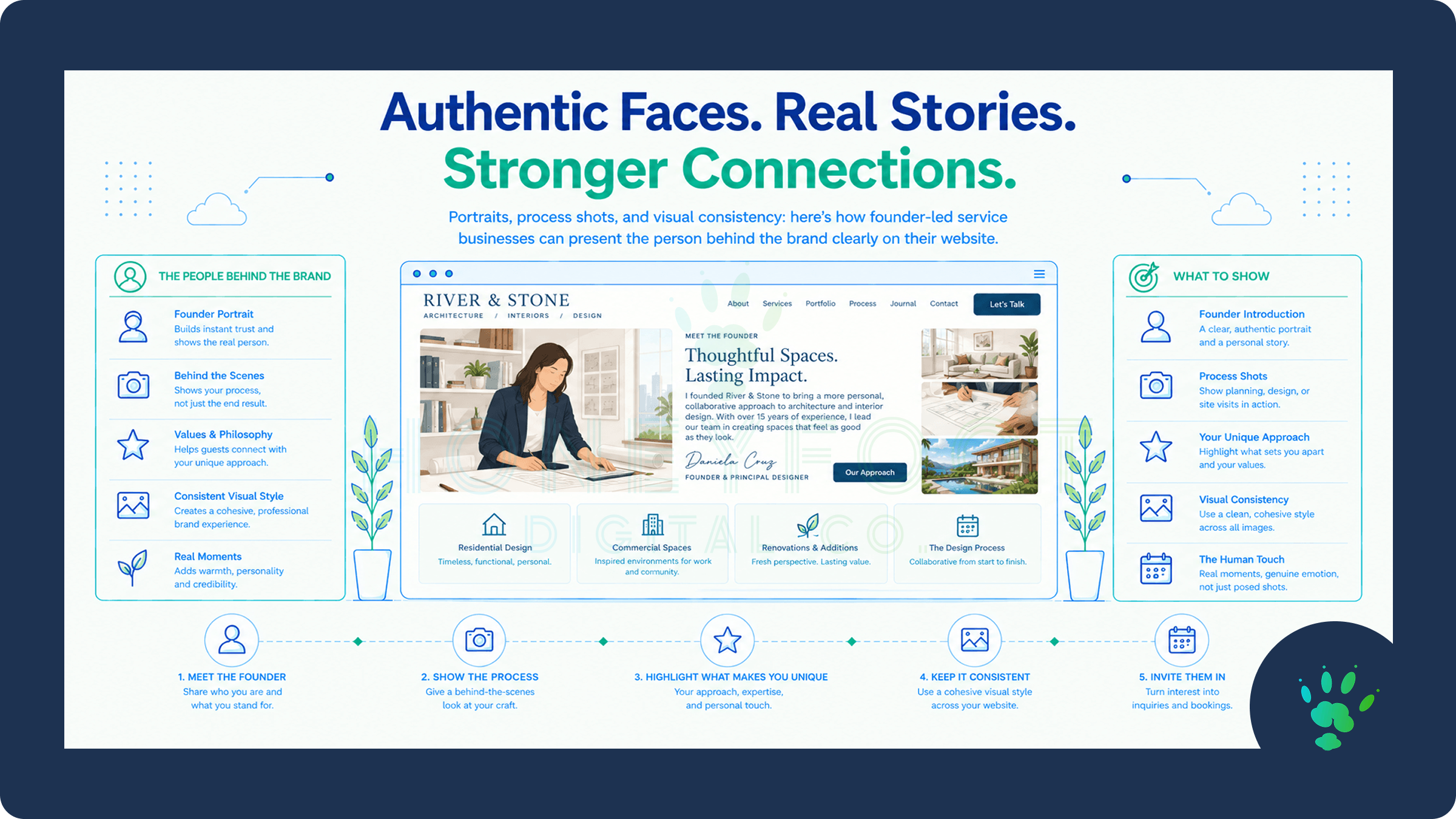
When the person is the brand, how they appear on screen is part of the service.
Ask a client what convinced them to hire a private chef, a planner, or the owner of a small spa, and the answer is rarely a list of services. It is usually a feeling about the person. They seemed relaxed, they seemed to care, their work looked like something I would want. That impression forms quickly, and on a founder-led business website it forms largely through images.
The previous article in this series explained why founder-led service businesses need a different approach to web design and strategy, and argued that the website has to carry the person. Photography is where that idea becomes visible. How the founder appears on screen, and how the work around them is shown, answers a visitor's unspoken questions more directly than any paragraph of copy can.
This article looks at how to do it well: what to photograph, how to brief a shoot, where the founder belongs on the site, and how to keep the images fast, findable, and current.
Why the Founder's Image Carries So Much Weight
On a property's website, photography shows a place. Visitors judge the rooms, the light, and the setting. On a founder-led website, photography shows a person at work, and visitors judge something harder to name: warmth, composure, taste, and whether this is someone they would trust in their home, at their wedding, or with their calendar.
That judgment is made quickly and rarely stated out loud. A client does not think that they would like a founder with natural light and a relaxed expression. They simply feel more or less at ease. The job of the founder's imagery is to make that feeling accurate, so that the person who appears on screen is recognizably the person who arrives at the door.
That matters more than it first appears. A founder-led business is sold on a promise about one particular human being. If the images suggest a polished, remote figure and the person is in fact warm and hands-on, the mismatch registers at the first meeting, and it registers as a small breach of trust. Images that tell the truth about the person do the opposite.
Start With a Portrait That Looks Like Them
Most founders have a portrait they dislike: a studio headshot against a gray backdrop, taken years ago for a directory listing. It is competent and says almost nothing. The stronger approach is a portrait made in context, with the person in the setting where they do their best work. A chef in their kitchen before service. A planner walking a venue with a notebook and a coffee. A spa owner in the treatment room they designed.
A few choices make the difference. Clothing should be what the person would actually wear on the job, refined but not reinvented. The expression should be the one clients see in a good conversation, which usually means mid-thought or mid-smile and not a held pose. Retouching should be restrained, because clients will meet the real person, and a portrait smoothed beyond recognition invites doubt the moment they do.
One primary portrait, used with care, is usually better than many. It becomes the face of the business, appearing on the about page and in a few other considered places, and its familiarity is part of its value. Supporting images can vary, but the main portrait should be strong enough to answer the question a visitor is quietly asking, which is simply who this is.

Show the Craft, Not Only the Face
A portrait tells visitors who the person is. Images of the work tell them how that person operates. For a founder-led business, the most persuasive photography often sits between the two: the founder's hands plating a course, adjusting a floral arrangement, or walking a client through a plan on a tablet.
These images carry information that copy struggles to convey. They show the care taken over small details, the pace of the work, and the way the founder interacts with clients and with their own team. Detail shots, such as tools, materials, handwritten notes, and preparation, add texture and make the process feel real and considered. Process imagery reassures because it shows a person doing the thing a client is hoping will be done well on their behalf.
Images that include clients are powerful and need care. A candid moment between a founder and a client conveys rapport better than anything staged, but it should only be used with clear permission, and many luxury clients will prefer not to appear at all. Detail-led images that suggest the occasion without identifying the people involved often serve both goals.

Consistency Is What Makes It Feel Like One Brand
Founder-led websites often collect images from many sources: a headshot from one photographer, event photos from another, a few phone snapshots, and a handful supplied by clients. Each may be good on its own. Together they read as a patchwork, and a patchwork undermines the impression of care that the business depends on.
The principle laid out in the photography standard luxury hospitality websites actually need applies directly here. Consistency of lighting, color treatment, framing, and mood matters more than the quality of any single image, because visitors judge the system as a whole. A founder's images should look as though they belong to the same person and the same body of work. A single photographer, or a clear set of guidelines when several are involved, keeps that coherence.
Consistency also means a considered balance between images of the person and images of the work. A site made only of portraits can feel self-focused, and a site with no person in it slides back into the generic service page. The right mix lets each type support the other.
Briefing a Photographer for a Founder-Led Shoot
The best founder photography is usually made during real work and not in a separate staged session. Photographing a genuine engagement, an actual tasting, a real site visit, or an ordinary day in the studio captures natural movement and expression that a posed session rarely does. It also produces images that match the work clients will actually receive.
A useful brief starts with the story the images need to tell and works backward to a shot list. A typical list for a service business includes an opening or arrival moment, the founder in conversation, the work in progress, a set of close details, and a small number of portraits made in the working environment. The photographer should know the founder's preferences, including how they feel about being watched while they work, and should be able to stay unobtrusive.
Permissions deserve the same planning. If clients, staff, or venues will appear, obtain releases and agree in advance how the images may be used. Settling where and for how long images can appear, in writing, avoids awkward conversations later and protects the discretion that luxury clients expect. It is part of the engagement and not an afterthought.
Where the Founder Belongs on the Site
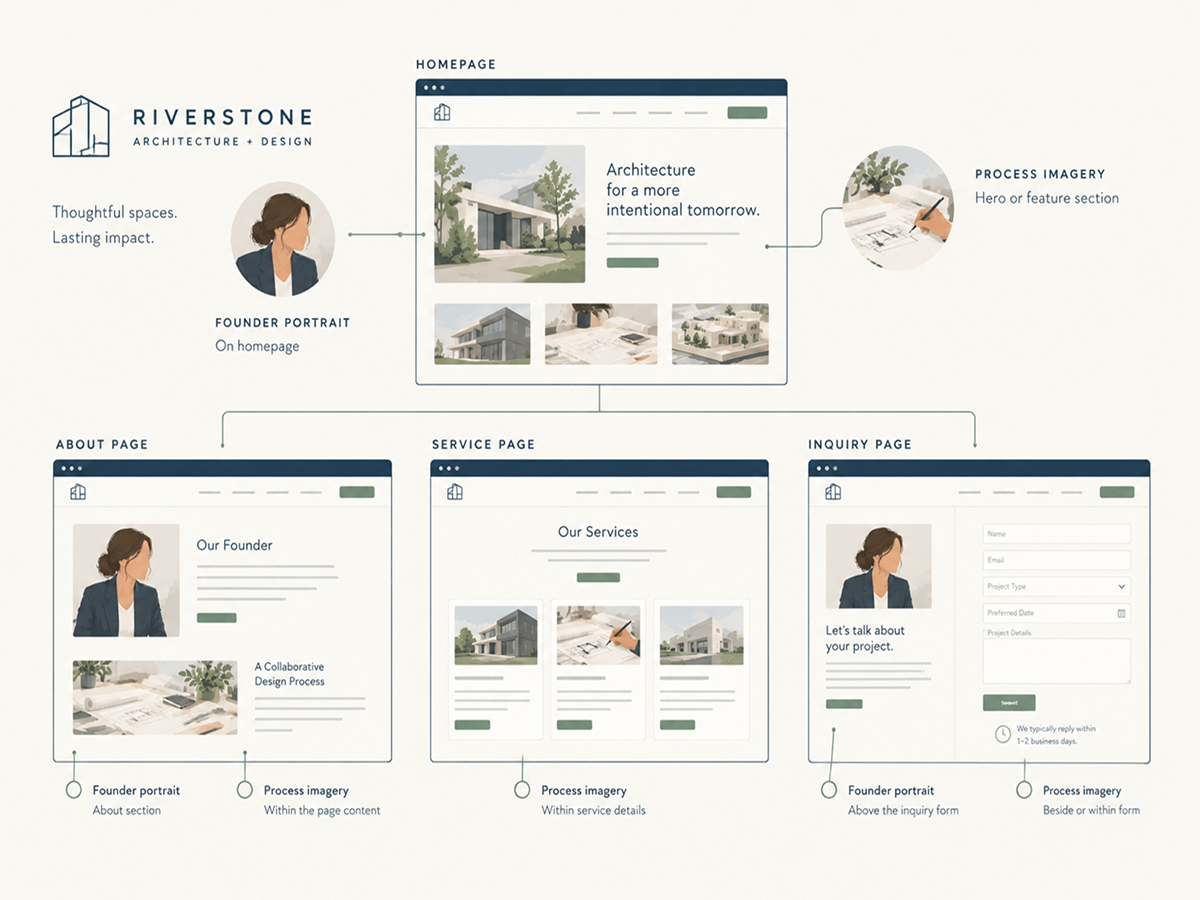
Presence should be deliberate and not constant. The founder's portrait and voice belong prominently on the about page, near the inquiry form, and in a considered place on the homepage, where a visitor first needs to sense who stands behind the work. Service pages benefit from supporting images that show the founder doing the relevant kind of work, so each offering feels tied to the person who delivers it.
Repetition without purpose dilutes the effect. A face in every section becomes decoration. Careful placement, with the founder appearing where a visitor is deciding whether to trust and where they are deciding whether to reach out, keeps the images meaningful. The inquiry page deserves particular attention, because a familiar, friendly face beside the form reminds a visitor that a real person will read what they write.
Most visitors will meet the founder on a phone, and a portrait that works on a wide desktop screen can fail on a narrow one. Faces get cropped awkwardly, and a carefully composed scene becomes a blur of background. Each key image should be checked at phone width, with its focal point set so the face and hands stay in frame. Where a single crop cannot serve every screen, web.dev notes that different images can be served to different viewports, which lets the composition be adjusted instead of simply shrunk.
Keeping the Images Fast, Findable, and Accessible
Beautiful images carry a cost if they slow the page. Website speed and conversions explains how loading time affects visitors, and large photography is one of the most common causes of delay. web.dev's guidance on image performance recommends serving images at the right size for their container using responsive techniques. The portrait or main image at the top of the page belongs in the first group and should load right away.
Discoverability and accessibility overlap here. Google's image guidance describes alt text as the most important metadata for an image and advises writing it descriptively and in context, without filling it with keywords. For a founder portrait, that means describing what is actually shown, such as for example, the founder preparing a tasting menu in a restaurant kitchen, and not repeating a search phrase. Google also recommends short, descriptive file names and placing images near text that relates to them. These habits help search engines understand the images, and they help visitors who use screen readers understand them too.
Keeping the Imagery Current
A founder and their work both change. A portrait from five years ago, or images in a style the person has since moved beyond, quietly undersell the business. Clients who meet the founder after seeing outdated images notice the gap, even if they never mention it.
A light refresh each year, with new portraits when the person's look or role changes and new process images as the work evolves, is usually enough. Between those updates, ordinary opportunities help: an engagement with a good photographer present, a new venue or kitchen, a signature project. Building a small, steady library of strong images makes updating the site easy and keeps it feeling alive.
Images That Tell the Truth About the Person
Founder-led businesses succeed when clients feel they know the person before they meet them. Photography is the fastest way to build that familiarity and one of the easiest to get wrong. The standard is not glamour. It is accuracy, consistency, and care: a portrait that looks like the person, images of the work that show how they think, and a technical foundation that lets all of it load quickly and be found.
Done well, the images quietly do what the rest of the site does in words. They tell a visitor who will be looking after them, and they make that person easy to say yes to.
Does your website show the person your clients are about to trust? If the only portrait is one from years ago, that is usually the answer. Whether you have strong work and very little of yourself in the frame, or a mix of images that never quite feel like one brand, let's have a conversation that starts with how your website presents you and the work you do. From there, a visual presence worthy of the person behind the business is well within reach.
Sources and Further Reading