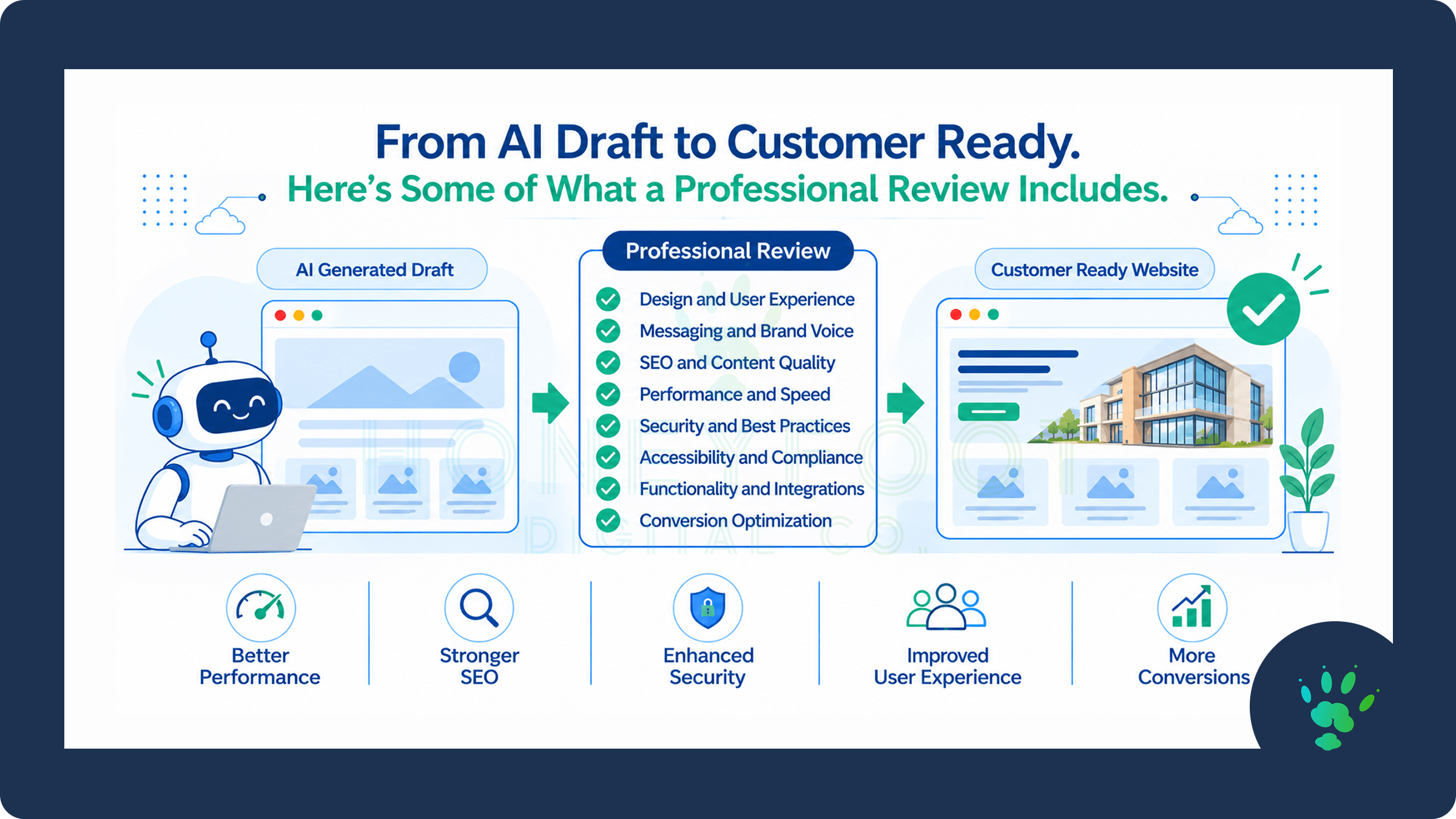
AI can produce a first draft quickly. Building a website that performs for your business is a different job.
A website built with AI tools can look finished long before it is ready to do business. The tools can generate a layout, some copy, and a working structure quickly, and the result may look convincing at a glance. But what looks finished depends on who is looking. The things that decide whether a website brings in customers, expresses a brand, and reaches a business goal are largely invisible on the surface: how it is structured, how fast it loads, whether it can be found, whether it can be maintained, and whether it says anything specific enough to earn trust.
This article is not a how-to for finishing the work yourself. It explains what a thorough professional review actually examines, so that an owner with an AI-built site can understand the gap between a draft and a high-performing website, and know what to ask for.
Why Does an AI-Built Website Look Finished When It Isn't?
Because the visible layer is the easiest part to generate. A coherent layout, a clean color palette, and confident copy pass the glance test. Most of what decides whether a site performs sits underneath, in places a glance cannot reach: how pages are structured for search engines, how quickly content loads on a mid-range phone, whether forms deliver messages, and whether the claims on the page are true.
Opinion plays a part as well. One person's finished-looking website is another person's template, and without clear goals and a trained eye there is no reliable way to judge whether a site is doing its job. An AI tool also builds what it is asked for. The things an owner did not know to ask for, such as indexing, performance, or ownership, are simply absent. That is not a flaw in the tool. It is the reason experienced judgment matters.
It is worth being specific about what a draft leaves out. A website that expresses a brand and achieves its goals reflects hundreds of small decisions: what the page hierarchy emphasizes, how the typography and imagery feel, what a visitor is asked to do and when. Those decisions come from understanding the business, the audience, and what success looks like for both, and they are rarely made well by default. A tool can produce options. Choosing among them, and knowing why, is the design work itself.
Can Search Engines and Customers Find It?
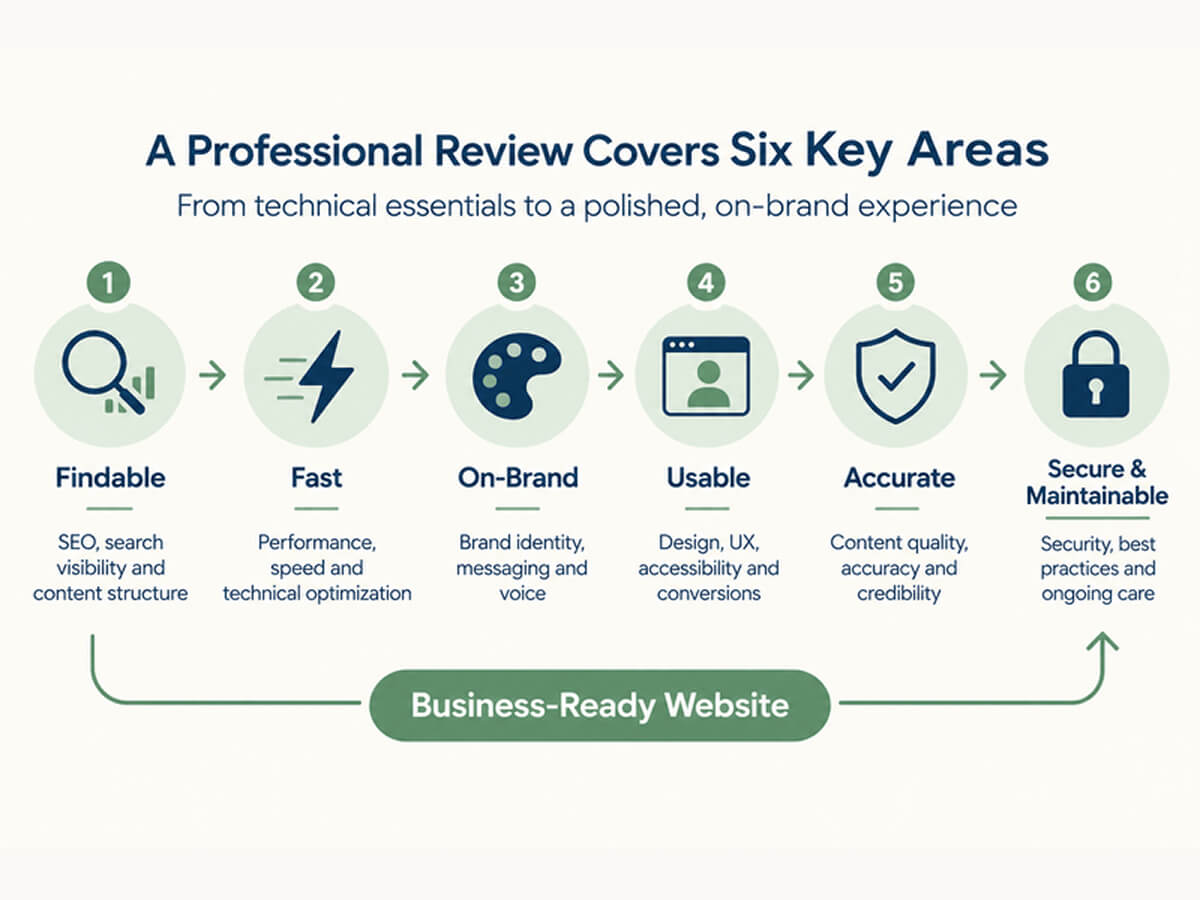
A professional review begins with findability. That means distinct titles and descriptions for each page, a clear heading structure, pages that search engines can reach and index, and enough genuine, useful content to deserve a place in results.
Content deserves particular scrutiny. Google's guidance on generative AI content does not ban AI-generated material, but it says the work must meet Google's Search Essentials, and that using these tools to generate many pages without adding value for users may violate its spam policy on scaled content abuse. The same guidance notes that generative models produce likely word sequences and not retrieved facts, so content needs to be fact-checked, on-brand and reviewed before it is published.
The practical reading is that a site does not need to hide how it was made, but it does need to be accurate, useful, and written with the specific knowledge that only the business has. That standard takes editorial care, and it is also what makes content worth quoting in AI answers.
Is It Fast Enough on a Real Phone?
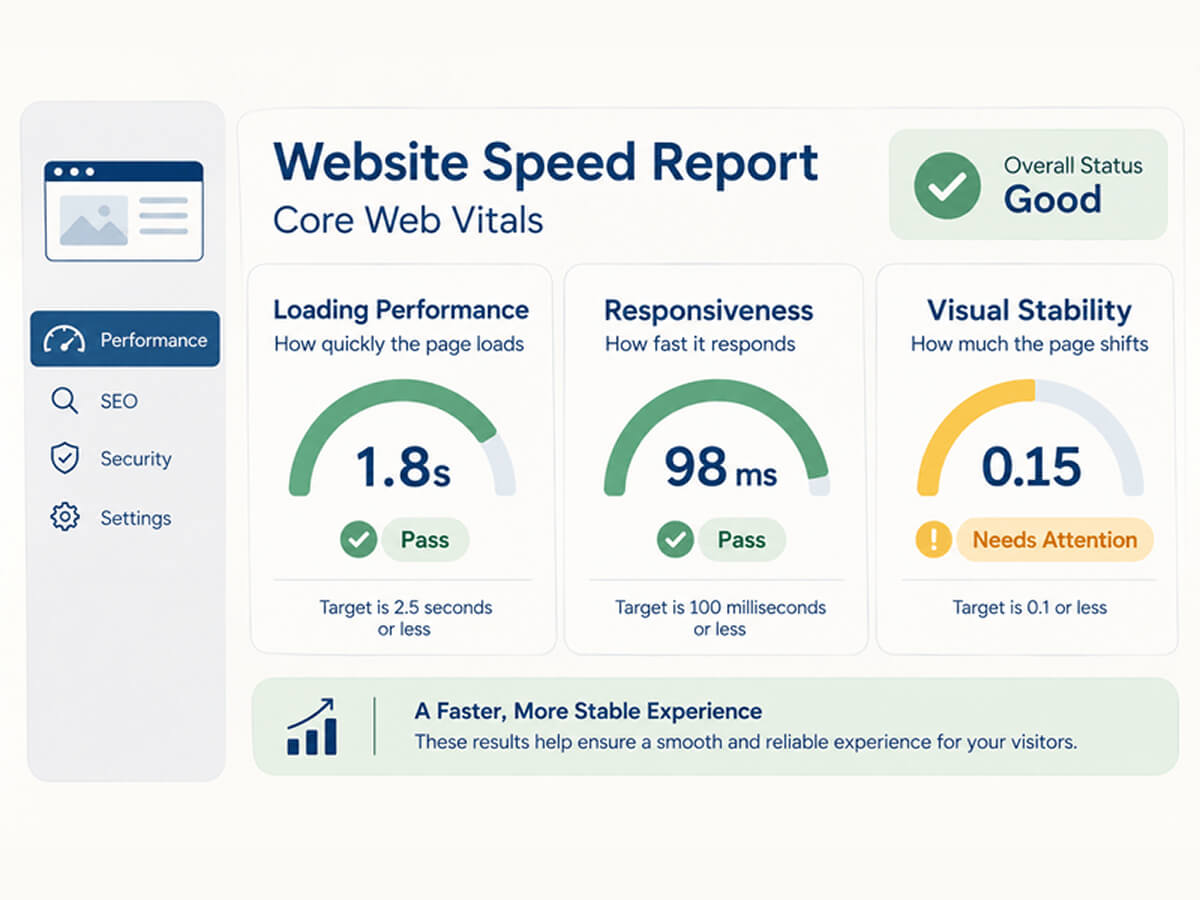
Speed is one of the most common gaps, and it is measurable. web.dev's Core Web Vitals describe three signals that Google recommends every site owner measure. Largest Contentful Paint should occur within 2.5 seconds of the page starting to load. Interaction to Next Paint should be 200 milliseconds or less. Cumulative Layout Shift should stay at 0.1 or less. These targets apply at the 75th percentile of page loads, so they reflect what most visitors experience and not the best case.
Generated sites can drift outside those numbers for ordinary reasons. Images may be larger than the layout needs, scripts may load that no page uses, and content may jump around as fonts and images arrive. Diagnosing the cause, and correcting it without breaking something else, takes development experience. As explained in website speed and conversions, delay costs real customers, which is why speed is measured on real devices and connections and not only on a fast office network.
Does It Work for Every Visitor and Every Device?
A page can look excellent on the screen it was designed on and fail elsewhere. Text may be too small or too faint to read, buttons may be hard to tap, menus may break on a narrow screen, and some visitors may not be able to navigate the site with a keyboard or a screen reader at all. Professionals test across devices, browsers, and ways of interacting, because a site is only as good as its worst experience.
Forms get their own testing, because they are where visitors become customers. Every form is submitted end to end, the message is confirmed to arrive where it should, the confirmation is checked, and spam filtering is verified. A form that looks fine and delivers nothing is one of the most expensive problems a website can have, because no one knows what was lost.
Is What It Says Accurate and Distinctly Yours?
A review also reads the site as a prospective client would. Do the services, prices, hours, locations, and credentials match reality? Does anything sound as though it could belong to any business in the industry? Generic copy is a quiet cost. It fails to separate the business from its competitors, and it gives visitors, and the systems that summarize websites, nothing specific to remember.
This is where brand matters as much as design. A site that exemplifies a business is built from real examples, real processes, and the opinions of the people who actually do the work, translated into pages that only that business could have written. It takes a clear understanding of the brand, and of the customer, to get there.
What Does a Business-Ready Website Include That AI Rarely Adds?
Beyond the areas above, a business-ready website includes a handful of things that are easy to overlook because they are not part of how a site looks. The first is a clear path to action. Every page should make it obvious what a visitor can do next, whether that is booking, requesting a quote, or calling, and the path should feel natural and not buried in a menu. Generated layouts can include a button without a plan for the journey that leads to it.
The second is evidence of trust: genuine photography of the business and its people, testimonials from real clients, credentials, and clear contact details. Stock imagery and invented-sounding praise do more harm than silence, because visitors tend to sense when something is generic. If the business does not yet have reviews, honest specifics about the work and the process carry the load until it does.
The third is measurement. A site with no analytics, or analytics that were never connected properly, cannot tell its owner which pages bring in customers or where visitors leave. Basic tracking of visits, form submissions, and calls turns a site that exists into a site that can be improved. Finally, the ordinary pages visitors expect, such as an about page, clear contact information, and privacy information, should be present and accurate. What a particular business is required to publish depends on where it operates and what it collects, so that is worth confirming with the right professional.
Who Owns It, and Can Anyone Maintain It?
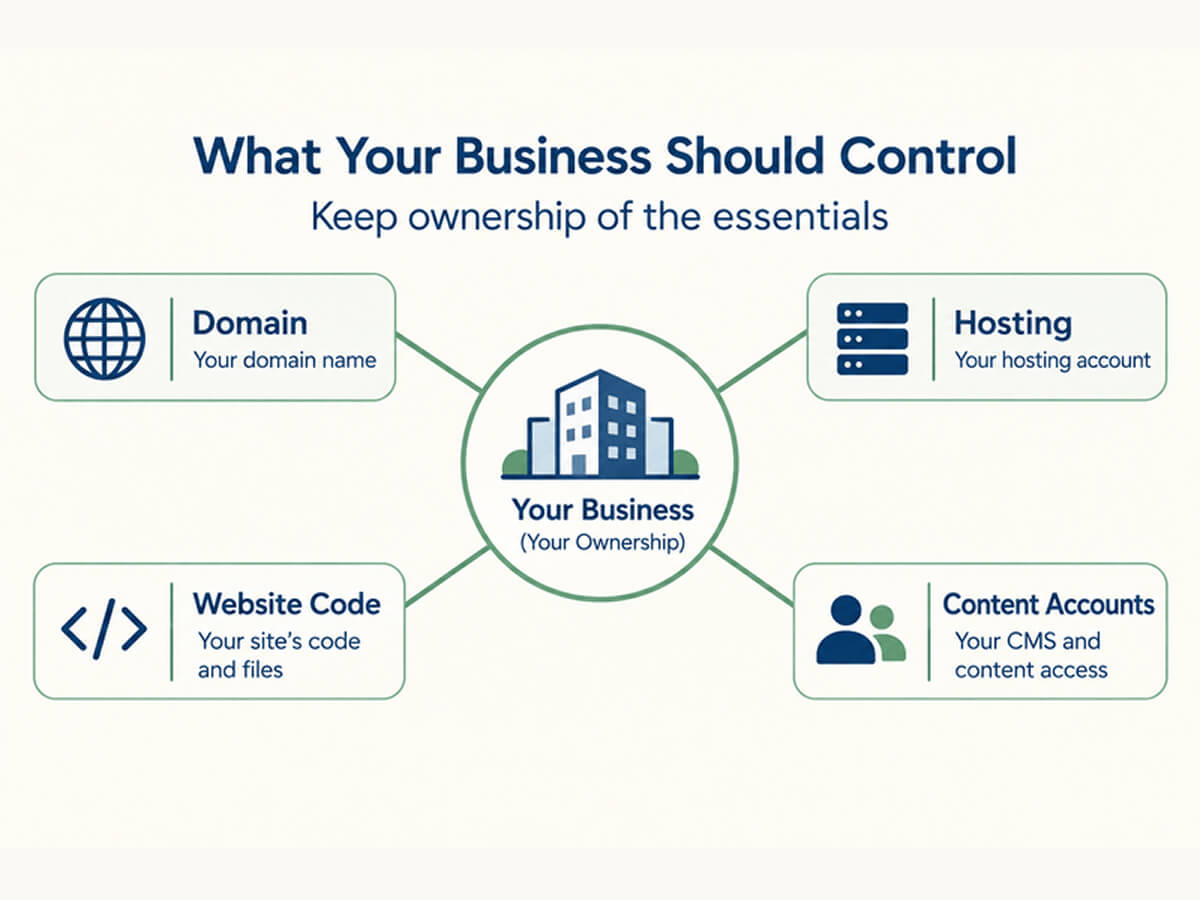
Ownership is the question owners most often skip, and it is easiest to settle early. A review confirms that the domain is registered in the business's name, that hosting accounts and any website-builder subscriptions sit under logins the business controls, and that the code and content can be exported. If a freelancer or a platform holds the keys, the business is renting its own website.
Maintainability matters just as much. A site needs regular updates, backups, security checks, and someone who understands how it was put together. Generated code can be hard for a new developer to read if nothing was documented, so it is worth asking what would happen if the person who built it were unavailable for a month. The things a proper plan covers are laid out in what a website maintenance plan should actually include.
What Does a Professional Bring That an AI Tool Doesn't?
Professional developers and studios use AI tools too, where the tools help. What they bring is the judgment around the tool: a strategy that starts from the business's goals, a brand expressed with intention, technical decisions made for performance, security, and longevity, and accountability for the result. They also know what to ask for, which is the one thing a tool cannot supply on its own.
A website that expresses a brand and achieves its goals is the product of those decisions, made in the right order and then looked after over time. That is the substance of experienced web design and development work, and it is the difference between a site that is present and a site that performs.
Should It Be Polished or Rebuilt?
That is a judgment call, and it can only be made by looking beneath the surface. If the structure is sound and the technical foundation is reasonable, the work may be refinement: tightening the copy, improving speed, fixing forms, and adding what is missing. Some sites rest on foundations that cost more to repair than to replace, such as code no one can maintain, a platform that cannot do what the business needs, or a structure that works against search engines.
The right answer depends on the business's goals as much as on the code. A site meant to take bookings or sell products has different requirements from a simple brochure, and the recommendation should be explained in those terms. A good assessment puts the decision in plain language, lays out the trade-offs, and says so when only a little work is needed.
What Should You Do Next?
There is nothing you need to fix yourself first. Before speaking with a professional, it helps to gather what will make the conversation useful: the address of the site, the tools and accounts it was built with, who holds the logins for the domain and hosting, what the site is meant to achieve, and anything you already suspect is not working, such as a form that seems quiet or pages that never appear in search.
A thorough assessment covers each of the areas above and returns a plain-language account of what it found, what matters most, and what it would take to address. Sorted by what affects customers first, that account is what turns a site that is present into a site that works. The draft AI produced may hold good ideas about structure, tone, and content that are worth keeping. The next stage is deciding which of them serve the business, and building the rest properly.
Is your AI-built website ready to do business, or only ready to be seen, or neither? If you're not sure, a professional assessment can answer that. Whether you have a site that looks right but brings no inquiries, suspect something underneath needs attention, or simply want experienced eyes on what you've built, let's have a conversation that starts with an honest assessment of what your website still needs. From there, getting from built to business-ready is a well-defined and achievable next step.
About the Author
Honeyfoot Co is a founder-led boutique web development studio based in South Florida, where clients work directly with studio leadership for a more personal, hands-on experience. The studio designs, builds, and maintains websites for business owners across the United States, and offers SEO and content strategy (including optimization for AI answers and AI search), e-commerce, website maintenance, and strategic consultation.
Sources and Further Reading
Google Search Central: Google Search's Guidance on Generative AI Content on Your Website