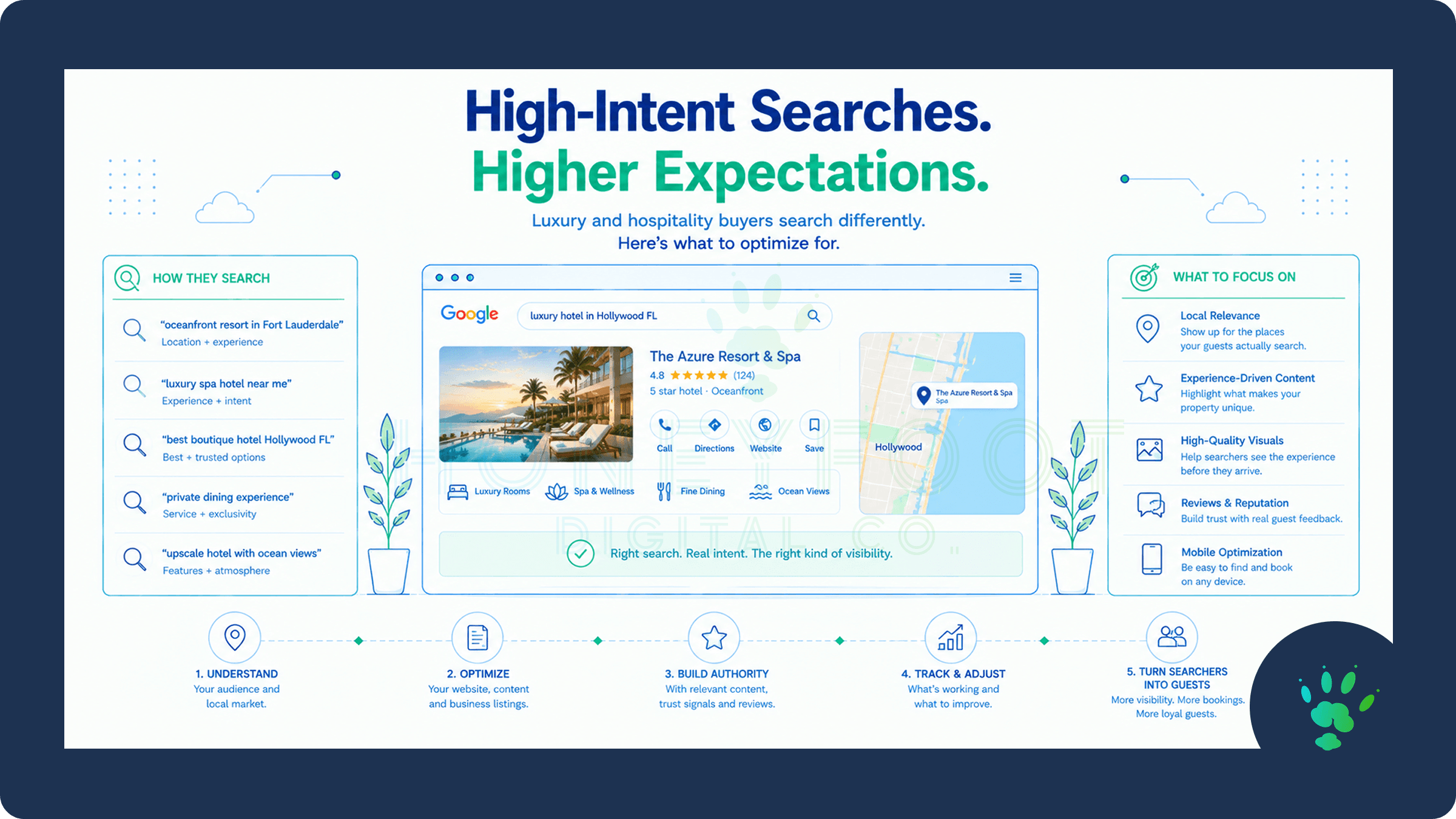
Distance, Relevance, and Prominence Mean Something Different for a Destination Business
Most local SEO advice is written for a specific kind of business: a plumber, a dentist, a hair salon, something a searcher needs nearby and needs soon. That advice centers almost entirely on proximity, because for those businesses, proximity is usually the whole decision. A hospitality or luxury service business is frequently playing a different game entirely, and applying convenience-business SEO thinking to a destination business tends to produce strategy aimed at the wrong target.
Understanding where local search behavior actually diverges for this category, and where it doesn't, makes the difference between a local SEO strategy that looks reasonable on paper and one that actually reflects how a prospective guest finds and evaluates a business like this.
Why "Near Me" Isn't Always the Right Target
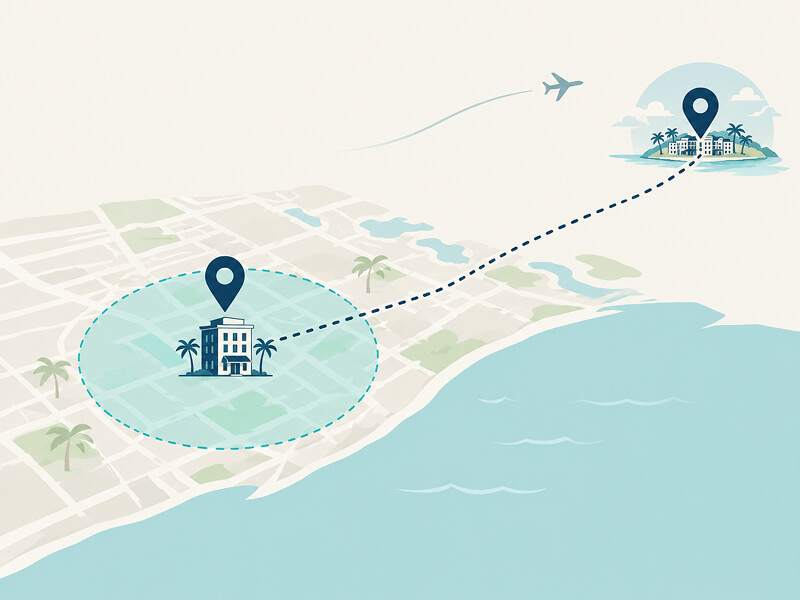
A huge share of local SEO strategy is built around capturing "near me" search intent, and for good reason, since that behavior drives enormous volume for convenience-based businesses. But a meaningful share of the searches that matter most to a hospitality or luxury service business don't look like that at all. A traveler isn't searching "boutique hotel near me" from their couch. They're searching "boutique hotel [destination]" or "luxury venue [city]" from somewhere else entirely, planning a trip to a place they don't currently live near.
This matters because optimizing purely for proximity-based local intent, treating every search as if it's coming from someone standing nearby right now, misses a large share of the actual audience for this category of business. The right target is often a blend: genuine proximity searches from local clientele alongside destination-intent searches from people who aren't nearby yet but are actively planning to be.
The Three Factors, Applied Differently Here
Google's own guidance is direct about what actually determines local ranking: relevance, distance, and prominence, working together rather than any single factor dominating. Each of these plays out differently for a destination-oriented business than it does for a convenience business.
Distance still matters, but its weight shifts depending on the search itself. A search including a destination name rather than "near me" phrasing changes how distance factors into the result, since the searcher has already specified where they're headed rather than asking what's closest to them right now. Relevance becomes especially important here: a listing needs to clearly and specifically communicate what kind of experience it offers, not just its general category, so it can actually match the more specific intent behind a destination-oriented search. Prominence, built from reviews, website strength, and how well-known a business actually is, matters just as much here as anywhere else, but it has to be built with a longer time horizon in mind for a business that's newer or still establishing itself.
Google Business Profile Still Matters, But the Content Has to Work Harder
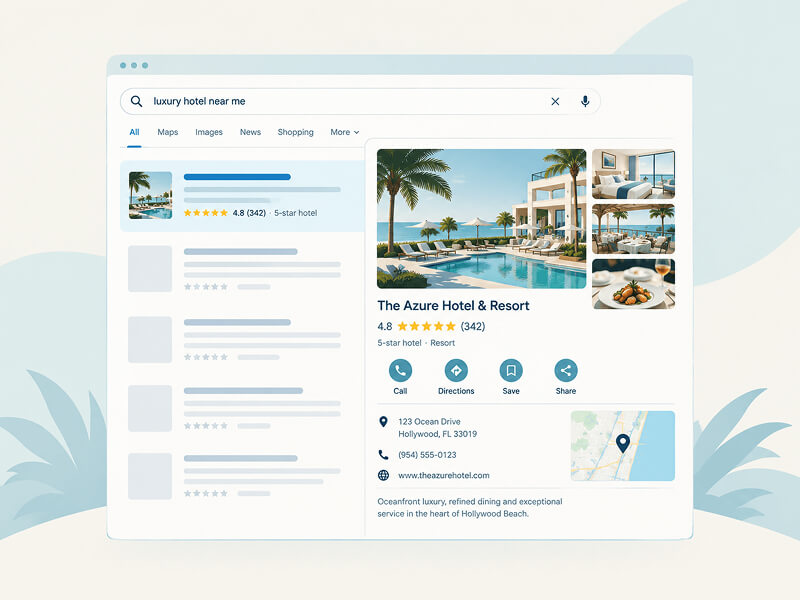
A complete, accurate Google Business Profile remains foundational regardless of business category. But for a hospitality or luxury service business, the content on that profile needs to do more communicative work than a simple category and hours listing. Generic amenity checklists undersell an experience that's actually being sold on atmosphere and distinction, the same principle that applies to the website itself.
Photos, descriptions, and posts on the profile should reflect the same positioning and visual standard as the rest of the site, not a stripped-down, generic version of it. A searcher's first impression of the business often happens directly inside the search results, before they've clicked through to the website at all, which makes this a genuine extension of the site's overall persuasive work rather than a separate, lower-stakes listing to fill out once and forget.
Website Content Has to Do More Work Than the Map Pack
For destination-intent searches specifically, a meaningful share of the decision-making process happens outside the local map pack entirely. A traveler researching where to stay or what venue to book for an event is often reading articles, comparing options across multiple open tabs, and evaluating businesses well beyond whatever three listings happen to appear in a local pack result. This is where a website's own content, not just its map listing, becomes a genuine competitive advantage.
A business with substantive, specific content addressing what a prospective guest actually wants to know, not just a generic homepage, has more surface area to be found and more material to actually build the kind of confidence a significant purchase requires. This is precisely the role a well-built content library plays: it isn't only about ranking for generic keywords, it's about being genuinely present and useful throughout the longer research process that a destination-intent search usually represents.
Reviews Are Part of Prominence, Built Over Time
Reviews are a real, meaningful factor in how prominence is calculated, and it's worth being honest about that rather than pretending they don't matter for this category. What's also worth being honest about is that review volume builds over time, and a newer or smaller business shouldn't expect to compete immediately with an established competitor's review count.
What actually matters in the interim is consistency and authenticity: genuinely asking satisfied guests for feedback at the right moment, responding thoughtfully to the reviews that do come in, and treating review growth as a steady, ongoing practice rather than a box to check once. A smaller but genuine, actively maintained review presence tends to serve a business better over time than either ignoring the practice entirely or attempting to shortcut it artificially, which carries real risk to both trust and standing with Google itself.
Location-Specific Content That Actually Supports the Right Intent
Beyond the core site and profile, content that speaks directly to specific destinations, occasions, or search intent tends to perform well for this category. A page or article addressing a specific occasion, a specific season, or a specific traveler need speaks directly to the way people actually search when they're planning something significant, rather than assuming every visitor arrives through an identical generic path.
This doesn't mean producing content for its own sake. It means recognizing that the discovery phase for this category of business is often longer and more research-driven than a single local search, and building content that actually serves that longer process, rather than optimizing exclusively for the shortest possible search-to-click path.
What This Looks Like in Practice
None of this means abandoning the fundamentals of local SEO. A complete, accurate, well-maintained Google Business Profile still matters, and so does a healthy review presence. What changes is the emphasis: treating distance as one factor among several rather than the dominant one, building website content substantial enough to support a longer research process, and maintaining relevance and prominence signals with a category of buyer in mind who is often planning ahead rather than searching for something immediately nearby.
A business that understands this distinction is positioned to actually capture the searches that matter most to it, rather than optimizing for a search pattern built for a fundamentally different kind of business.
When you search for your own business the way a prospective guest actually would, destination-first rather than "near me," does what you find reflect the business you've actually built? If the honest answer is that your local presence feels generic or incomplete, that's a solvable gap, and often a faster one to close than most business owners expect. Let's take a look at how your business actually shows up in search.
Sources and Further Reading: